
Of all the intermittent fasting methods I researched before starting, 16:8 intermittent fasting is the one I kept coming back to. Not because it sounded the most impressive. Because it is the most studied, the most practical, and the one with the most consistent results across the widest range of people.
The 16:8 fasting schedule means fasting for 16 hours and eating during an 8-hour window every day. That is it. Most people structure it as stopping eating at 8pm and having their first meal at 12pm the following day. The fasting window runs mostly overnight and through the working morning, which makes it far less disruptive than it sounds.
My wife and I have both been on 16:8 at various points and have since moved to 18:6. But 16:8 is where both of us saw our first real results. She lost the bulk of her 5kg at 16:8 before we extended further. I lost my belly fat and stabilised my energy at 38 on 16:8. It is also the schedule I recommend to everyone who has completed two weeks of 14:10 and is ready to progress.
This is the complete guide to 16:8 intermittent fasting: how it works, the exact schedule, what to eat, the results you can realistically expect, and who it is and is not suitable for.
For the complete intermittent fasting framework, the intermittent fasting diet plan covers every method and schedule. If you are completely new to IF, start with the intermittent fasting for beginners guide first.
What Is 16:8 Intermittent Fasting?
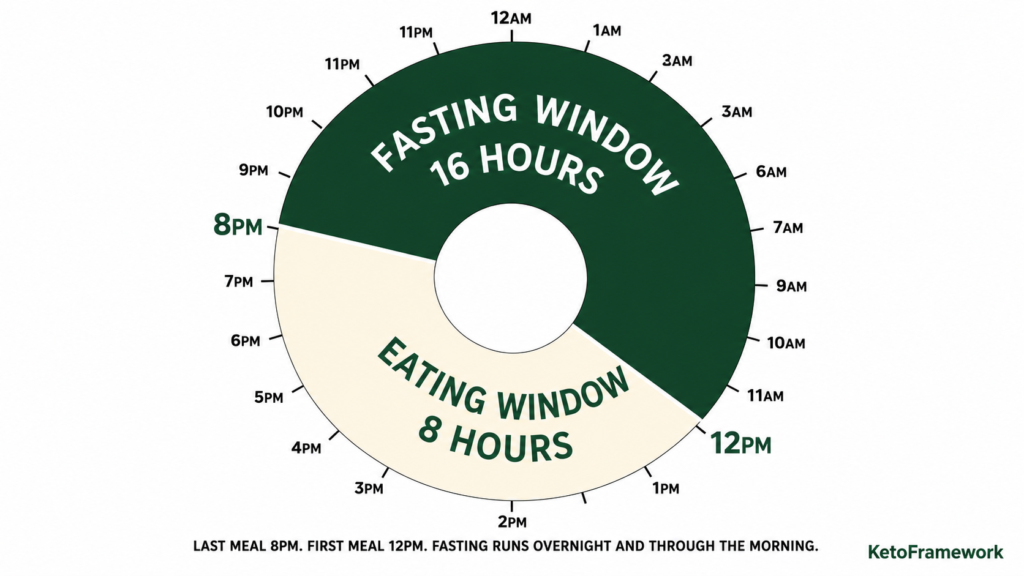
16:8 intermittent fasting is a time-restricted eating protocol in which you fast for 16 consecutive hours and eat all of your meals within an 8-hour window. The numbers refer to the ratio of fasting hours to eating hours across a 24-hour day: 16 hours fasting, 8 hours eating.
The most common 16:8 fasting schedule is:
Last meal: 8pm
First meal: 12pm the following day
Eating window: 12pm to 8pm
Fasting window: 8pm to 12pm (16 hours)
The 16-hour fasting window runs from the time you finish eating in the evening through to noon the next day. Because most of this time overlaps with sleep (typically 7 to 9 hours) and the working morning, the practical experience of 16:8 is much less demanding than the 16-hour figure suggests. Most people are asleep for 7 to 8 of those hours and occupied with morning work or routine for another 3 to 4. How Does 16:8 Fasting Work? The Mechanism
Understanding why 16:8 intermittent fasting produces results requires understanding one hormone: insulin.
The insulin mechanism
Every time you eat, blood glucose rises and your pancreas releases insulin to manage it. Insulin moves glucose into cells for energy and stores the excess as glycogen or fat. Critically, while insulin is elevated, your body cannot access stored fat for fuel. Fat burning is suppressed for as long as insulin remains high.
On a standard eating pattern of three meals and snacks spread across 14 to 16 hours of the day, insulin is elevated for most waking hours. The body rarely gets a sustained window where insulin is low enough for significant fat oxidation to occur.
The 16:8 fasting schedule changes this by creating a 16-hour gap between the last meal and the first meal. After the last meal is digested, insulin falls over roughly 4 to 6 hours. It then stays low for the remaining hours of the fasting window. During this sustained low-insulin period, the body begins drawing on stored fat for fuel rather than food just eaten.
What happens during the 16-hour fasting window
The metabolic changes across the 16-hour fasting window follow a consistent pattern:
Hours 0 to 4: Digesting the last meal. Insulin elevated. Glucose being used for energy.
Hours 4 to 8: Insulin returning to baseline. Blood glucose stabilising. Glycogen beginning to be drawn on.
Hours 8 to 12: Insulin at baseline. Body drawing actively on liver glycogen. Fat oxidation increasing.
Hours 12 to 16: Liver glycogen substantially depleted. Fat oxidation running meaningfully. Some people begin producing measurable ketones in this window.
By the time the eating window opens at 12pm, the body has been in a fat-burning state for several hours. For a deeper look at the full biology, the guide on what is intermittent fasting covers the mechanism in full detail.
The 16:8 Fasting Schedule: How to Structure Your Day
The standard 16:8 daily schedule
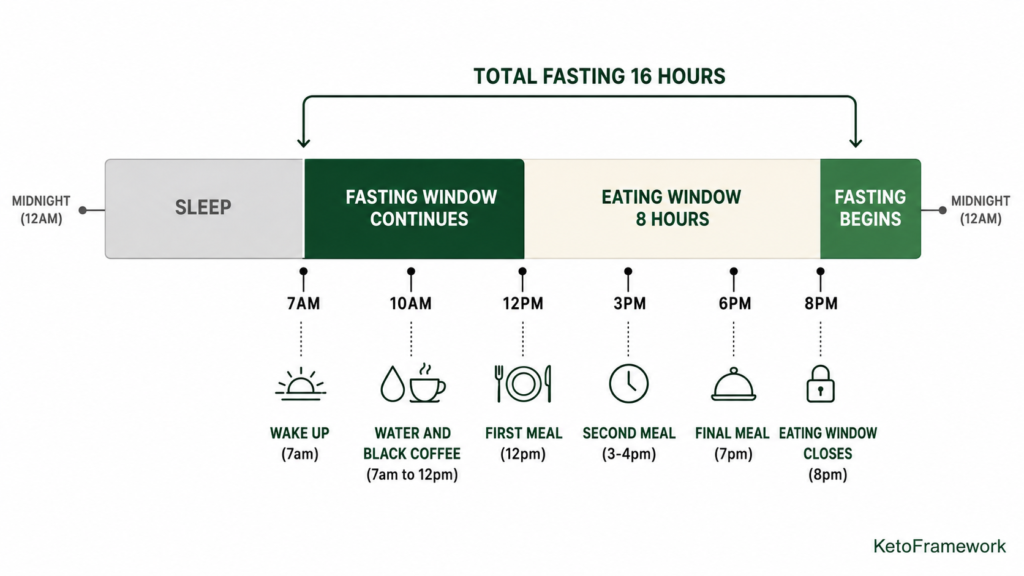
Here is what a typical day on 16:8 looks like in practice:
7am: Wake up. Large glass of water with a pinch of sea salt. The fasting window has been running since 8pm.
7am to 12pm: Water, black tea, plain black coffee (nothing added), sparkling water, water with lemon. Nothing else. All of these are metabolically neutral and do not break the fast.
12pm: Eating window opens. First meal. Protein and fat forward: eggs with avocado and leafy greens, or salmon with olive oil dressing.
3pm to 4pm: Second meal or substantial snack. Full-fat Greek yoghurt with mixed nuts, or a protein-forward light meal.
7pm: Final meal. Whatever is being cooked at home that evening, prioritising protein and vegetables.
8pm: Eating window closes. Water and herbal tea only from here. The fasting window begins again.
Adjusting the 16:8 schedule to fit your life
The 12pm to 8pm eating window is the most commonly used 16:8 structure, but it is not the only valid one. The fasting window needs to be 16 consecutive hours. The specific hours can shift to fit your routine.
• Early riser: try 10am to 6pm. Eating window opens at 10am instead of 12pm. Last meal at 6pm.
• Family eats late: try 1pm to 9pm or 2pm to 10pm. Adjust the open time to match your evening meal time.
The specific hours matter less than two things: the window is consistently 16 hours, and the times are held consistently every day including weekends. For the full guide to building a schedule that fits your life, the intermittent fasting schedule guide covers every variation.
16:8 Fasting Results: What the Research Shows
Here is what peer-reviewed research actually shows about 16:8 results, from three verified studies:
| Result | What the Research Shows | Timeline |
| Body weight reduction | Significant reduction of 1.48kg across 8 RCTs (Huang et al., 2023). | 6 to 12 weeks |
| Fat mass reduction | Fat mass reduced by 1.09kg on average across 8 RCTs (Huang et al., 2023). | 6 to 12 weeks |
| Fat loss without muscle loss | Fat mass decreased while fat-free mass, muscle area, and maximal strength were maintained (Moro et al., 2016). | 8 weeks |
| Blood pressure improvement | Systolic blood pressure decreased by an average of 7mmHg (Gabel et al., 2018). | 12 weeks |
| Natural calorie reduction | Participants reduced daily intake by approximately 341 calories without deliberate counting (Gabel et al., 2018). | 12 weeks |
| Improved inflammatory markers | Adiponectin increased and leptin decreased significantly in the 16:8 group (Moro et al., 2016). | 8 weeks |
Weight and fat loss
A pilot study published in PubMed (Gabel et al., Nutrition and Healthy Aging, 2018)[1] studied 16:8 in 23 obese adults over 12 weeks. Participants lost an average of 2.6 percent of body weight and reduced daily calorie intake by approximately 341 calories per day, without any deliberate calorie counting. Systolic blood pressure also decreased by an average of 7mmHg.
A meta-analysis published in PMC (Huang et al., Food Science and Nutrition, 2023)[2] analysed 8 randomised controlled trials on 16:8 in overweight and obese adults and found significant body weight reduction of 1.48kg and fat mass reduction of 1.09kg across studies. The consistency across 8 independent trials in different populations is what makes 16:8 the most confidently recommended IF protocol.
Fat loss without muscle loss
A study published in PMC (Moro et al., Journal of Translational Medicine, 2016)[3] examined 16:8 in resistance-trained males over 8 weeks. Fat mass decreased significantly while fat-free mass, muscle area of the arm and thigh, and maximal strength were all maintained. Inflammatory markers and cardiovascular risk factors also improved.
The finding that 16:8 can reduce fat without compromising muscle mass or strength is significant for anyone who trains and is concerned about losing muscle alongside fat.
Metabolic and health markers
Across the studies, 16:8 consistently shows improvements in: insulin sensitivity, systolic blood pressure, inflammatory markers including leptin and adiponectin, and in some populations fasting glucose. For the full realistic timeline week by week, the intermittent fasting results guide covers every stage.
How to Do 16:8 Fasting: A Step-by-Step Guide for Beginners

Step 1: Do not start at 16:8 on day one
If you are completely new to intermittent fasting, start at 14:10 for the first two weeks before moving to 16:8. Stop eating at 8pm and have your first meal at 10am rather than 12pm. This gives your hunger hormones two weeks to begin adapting. See the intermittent fasting for beginners guide for the full step-by-step starting protocol.
Step 2: Fix your fasting window close time first
Decide what time you will stop eating in the evening and hold it. For most people this is 8pm. For families with late evening meals it might be 9pm or 10pm. Whatever time you choose, hold it consistently. The fasting window close time is the anchor that determines everything else. Your first meal time is simply close time plus 16 hours.
Step 3: Manage electrolytes from day one
During the fasting window, your kidneys excrete more sodium because insulin is low. Sodium depletion pulls magnesium and potassium with it. The headaches, fatigue, and brain fog most people experience in the first week of 16:8 are primarily electrolyte depletion, not hunger. A quarter teaspoon of sea salt in a large glass of water first thing in the morning solves most of it. The full electrolyte protocol is in the electrolytes on keto guide, which applies equally to IF.
Step 4: Know what you can have during the fasting window
The fasting window allows: water, plain sparkling water, black coffee (nothing added), plain herbal tea, plain green or black tea, water with a squeeze of lemon, plain electrolyte powder with no sugar or sweetener. Nothing else. Milk, cream, sugar, sweeteners, protein shakes, and fruit juice all raise insulin and break the fast. The full breakdown is in the what can you eat while intermittent fasting guide.
Step 5: Break the fast correctly at 12pm
After 16 hours of fasting, insulin is at its lowest point of the day. Break the fast with protein and fat first: eggs with avocado and leafy greens, salmon with olive oil dressing, or full-fat Greek yoghurt with mixed nuts. This produces a moderate, measured insulin response and maintains satiety for 3 to 4 hours. The how to break a fast guide covers every scenario including keto, non-keto, and training days.
The 16:8 Fasting Meal Plan: What to Eat in Your 8-Hour Window
Meal structure for the 8-hour eating window
Two to three meals within the 12pm to 8pm eating window works well for most people on 16:8:
Meal 1 at 12pm: Protein and fat forward. 25 to 35 grams of protein. Eggs with avocado and leafy greens, or salmon with olive oil.
Meal 2 at 3pm to 4pm: Protein maintained. Full-fat Greek yoghurt with mixed nuts, grilled chicken with roasted vegetables, or sardines with cucumber and olive oil.
Meal 3 at 7pm: The evening meal. Whatever is being cooked at home. Prioritise protein and vegetables. Minimise refined carbohydrates.
Foods and categories for the 16:8 eating window
| Category | Foods |
| Proteins | Eggs, salmon, chicken breast and thigh, beef, lamb, sardines, tuna, full-fat Greek yoghurt, cottage cheese. |
| Healthy fats | Avocado, extra virgin olive oil, butter, coconut oil, mixed nuts and seeds, fatty fish. |
| Vegetables | Leafy greens, broccoli, courgette, spinach, green beans, cucumber, tomatoes, cauliflower. |
| Whole food carbs (later in window) | Sweet potato, brown rice, oats, legumes, wholegrain bread. Secondary meal components, not the opening meal. |
| Minimise (refined carbs) | White bread, white rice, pasta, pastries, commercial cereals, fruit juice. Should not open the eating window. |
For a complete 7-day meal plan built around the 16:8 schedule, the intermittent fasting meal plan covers every day with specific meals and the four principles behind the eating window.
16:8 Intermittent Fasting and Exercise
Training during the fasting window
Training in the morning during the fasting window is possible and for many people effective. Black coffee before a fasted training session does not break the fast and can improve performance by increasing adrenaline and fat mobilisation. The concern about muscle loss from fasted training is largely overstated for sessions of moderate intensity and normal duration. The Moro 2016 study confirmed that resistance-trained males maintained muscle mass and maximal strength on 16:8 over 8 weeks.
For high-intensity or long-duration training sessions, some people perform better with a small amount of food before training. In that case, adjust the schedule so training falls within the eating window rather than the fasting window.
Breaking the fast after training
If you train near the end of the fasting window, break the fast within 30 to 60 minutes of finishing your session. Prioritise protein at 30 to 40 grams in the first meal to support muscle protein synthesis. Eggs with salmon or chicken delivers this easily. On high-intensity training days, include a moderate amount of whole food carbohydrate such as sweet potato or oats alongside the protein to replenish glycogen.
Who Should and Should Not Do 16:8 Fasting
| Suitable For | Not Recommended Without Medical Guidance |
| Most healthy adults wanting to lose fat, improve metabolic health, stabilise energy, and regulate appetite without calorie counting. | Pregnant or breastfeeding women. |
| People who find traditional calorie restriction difficult to sustain because of hunger. | People with a history of eating disorders. |
| People whose daily routine allows for a consistent eating window around midday and evening. | People on medications that require food intake. |
| Anyone who has completed two weeks of 14:10 and is ready to progress. | People with type 1 diabetes or those managing blood glucose with insulin or glucose-lowering medications. |
| Children and adolescents. | |
| People with a history of hypoglycaemia. |
Who 16:8 fasting is suitable for
16:8 intermittent fasting is suitable for most healthy adults who want to lose fat, improve metabolic health, stabilise energy, and regulate appetite without calorie counting. It is particularly effective for people who find traditional calorie restriction difficult to sustain because of hunger, and for people whose daily routine allows for a consistent eating window around midday and evening.
Who should approach 16:8 with caution or avoid it
16:8 fasting is not recommended without medical guidance for: pregnant or breastfeeding women, people with a history of eating disorders, people on medications that require food intake, people with type 1 diabetes or those managing blood glucose with insulin or glucose-lowering medications, children and adolescents, and people with a history of hypoglycaemia.
If you have any existing health condition, consult your doctor or healthcare provider before starting 16:8 intermittent fasting.
Frequently Asked Questions About 16:8 Intermittent Fasting
How do I start 16:8 intermittent fasting?
Start at 14:10 for two weeks first. Stop eating at 8pm and have your first meal at 10am rather than jumping straight to 12pm. After two weeks of consistent 14:10, push the first meal back by one hour to 11am for three to four days, then to 12pm. You have moved to 16:8 without a single dramatically difficult day. The adaptation to the fasting window happens layer by layer. Skipping the 14:10 phase makes week one harder than it needs to be.
What can I drink during 16:8 fasting?
During the 16-hour fasting window: water, plain sparkling water, black coffee (nothing added), plain herbal tea, plain green or black tea, water with a squeeze of lemon, and plain electrolyte powder with no sugar. Nothing else. Milk, cream, sugar, sweeteners, protein shakes, and any food break the fast by raising insulin.
How long before 16:8 fasting shows results?
The first result from 16:8 is not weight loss. It is a reduction in morning hunger, which typically appears between day 5 and day 10 of consistent fasting. Visible changes on the scale appear in weeks 2 to 4. Meaningful fat loss is measurable at 6 to 12 weeks. For the full results timeline, the intermittent fasting results guide covers every stage.
Can I combine 16:8 fasting with keto?
Yes, and the combination is more effective than either approach alone. Keto lowers insulin by removing carbohydrates. 16:8 lowers insulin by extending the gap between meals. My wife and I both combine 18:6 with keto. For the complete guide to combining both, the intermittent fasting and keto guide covers exactly how to structure them together.
What is the difference between 16:8 and 18:6 fasting?
16:8 means 16 hours of fasting and an 8-hour eating window. 18:6 means 18 hours of fasting and a 6-hour eating window. 16:8 has a stronger research base and is the right protocol for most people starting IF or maintaining results long term. The guide on how long should you fast covers the difference between all fasting windows and what each one produces.
Is 16:8 fasting safe long term?
The available research on 16:8 over periods of up to 12 months shows no negative effects on muscle mass, resting energy expenditure, or health markers in healthy adults. The Moro research group followed resistance-trained males on 16:8 for 12 months and found continued improvements in cardiometabolic markers without adverse effects. For most healthy adults, 16:8 practiced consistently with adequate nutrition during the eating window is a sustainable long-term approach.
16:8 Intermittent Fasting: The One Thing That Makes It Work
16:8 intermittent fasting is the most researched intermittent fasting protocol for a reason. It is long enough to produce the sustained low-insulin state that drives fat burning and metabolic improvement. It is short enough that the 8-hour eating window fits comfortably into daily life, family meals, and social routines. And it is consistent enough that the hormonal adaptation it produces is durable rather than temporary.
The one thing that makes 16:8 work is not the specific hours. It is holding those hours consistently, every day, including weekends. The metabolic adaptation builds through daily repetition. One week of perfect 16:8 followed by an unstructured weekend resets part of the adaptation. Four weeks of consistent 16:8 including weekends produces the results the research shows.
Start with 14:10 for two weeks. Move to 16:8 when 14:10 feels natural. Hold 16:8 for at least four to six weeks before considering 18:6. The schedule does not need to be ambitious. It needs to be consistent.
The complete framework for every IF method, schedule, and meal structure is in the intermittent fasting diet plan. For understanding the full biology behind why the fasting window produces these results, the guide on what is intermittent fasting covers everything. And for the specific question of how to build the daily schedule that holds this approach across your real life, the intermittent fasting schedule guide is the practical companion to this one.
References
1. Gabel K, Hoddy KK, Haggerty N, et al. Effects of 8-hour time restricted feeding on body weight and metabolic disease risk factors in obese adults: a pilot study. PubMed, Nutrition and Healthy Aging, 2018. https://pubmed.ncbi.nlm.nih.gov/29951594/
2. Huang T, Zheng Y, Li J, et al. Is time-restricted eating (8/16) beneficial for body weight and metabolism of obese and overweight adults? A systematic review and meta-analysis of randomized controlled trials. PMC, Food Science and Nutrition, 2023. https://www.ncbi.nlm.nih.gov/pmc/articles/PMC10002957/
3. Moro T, Tinsley G, Bianco A, et al. Effects of eight weeks of time-restricted feeding (16/8) on basal metabolism, maximal strength, body composition, inflammation, and cardiovascular risk factors in resistance-trained males. PMC, Journal of Translational Medicine, 2016. https://www.ncbi.nlm.nih.gov/pmc/articles/PMC5064803/