
Most intermittent fasting meal plans I have seen online make the same mistake. They focus on what to eat during the eating window while treating the fasting window as a gap to endure. Then they pack the eating window with complicated recipes, elaborate macronutrient calculations, and a different meal for every day of the week.
That is not how my wife and I eat on IF. And it is not how most people who succeed with IF long term eat either.
The intermittent fasting meal plan that works is simple. It has a small number of well-composed meals that rotate. It prioritises protein at every meal. It uses real, whole food ingredients. And it does not require you to cook something different every day.
This article gives you the full picture: the principles behind a good IF food plan, what I actually eat on a typical day, and a complete 7-day IF weekly meal plan you can follow from day one or adapt to your own preferences. For the fasting window that runs alongside this meal plan, the intermittent fasting schedule guide covers the daily timing structure. For the biology of why food choices during the eating window matter, the guide on how to break a fast covers the mechanism in detail.
The Principles Behind a Good Intermittent Fasting Food Plan
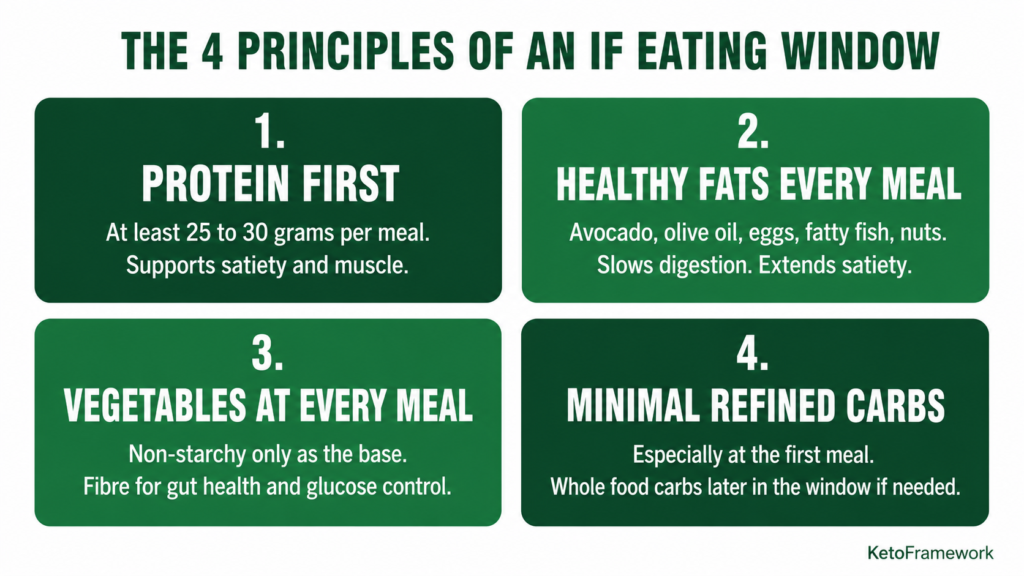
Before presenting the actual meal plan, here are the four principles that govern every meal in the eating window. Once these are understood, you can build any meal and know whether it works, regardless of what is in the fridge.
Principle 1: Protein at every meal, minimum 25 to 30 grams
Protein is the most important nutrient in an IF meal plan for weight loss. It regulates appetite, preserves muscle during a calorie deficit, and produces a more sustained satiety response than carbohydrates or fat alone. A review published in PubMed (Leidy et al., American Journal of Clinical Nutrition, 2015)[1] confirmed that diets providing at least 25 to 30 grams of protein per meal, within a daily intake of 1.2 to 1.6 grams per kilogram of body weight, produce measurable improvements in appetite control, body weight management, and cardiometabolic health.
In an IF eating window of 8 hours with two or three meals, hitting 25 to 30 grams of protein per meal adds up to 75 to 90 grams across the day, which is adequate for most people to maintain muscle and manage appetite effectively.
Practical 25 to 30 gram protein portions: 3 whole eggs plus 50 grams of salmon (approximately 28 grams total), 200 grams Greek yoghurt with a handful of nuts (approximately 25 grams), 150 grams chicken breast (approximately 35 grams), 150 grams salmon fillet (approximately 30 grams), 200 grams cottage cheese (approximately 24 grams).
Principle 2: Healthy fat at every meal
Fat slows gastric emptying, extends satiety, and moderates the glucose and insulin response of the meal. Every meal in the eating window should include a meaningful source of healthy fat. This does not mean adding fat for its own sake. It means including foods that naturally contain healthy fat: eggs, avocado, olive oil, fatty fish, nuts, full-fat dairy.
Principle 3: Non-starchy vegetables as the base
Non-starchy vegetables, leafy greens, broccoli, courgette, cucumber, spinach, green beans, provide fibre that supports gut health, slows glucose absorption, and adds volume to meals without meaningfully raising insulin. Every meal in the eating window should include vegetables.
Principle 4: Refined carbohydrates last, or minimised
Refined carbohydrates, white bread, white rice, pasta, pastries, sugary snacks, produce rapid glucose and insulin spikes that work against the metabolic benefit of the fasting window. They are not forbidden, but they should not be the first food of the eating window and should not dominate any meal. Whole food carbohydrates, sweet potato, oats, legumes, wholegrain bread, are a different matter: these digest more slowly and work well later in the eating window as a second or final meal component.
What I Eat on a Typical IF Day (16:8, 12pm to 8pm)

Here is exactly what my eating window looks like on a typical day. This is not a theoretical meal plan. It is what I actually eat, most days, with natural variation.
Fasting window (8pm to 12pm): water, black tea, black coffee (nothing added), sparkling water, water with lemon. That is it. The fast runs mostly while I sleep and through the working morning. I do not fight hunger during this window because, after several months of consistent 18:6, there is very little hunger to fight.
12pm: first meal
Eggs (2 to 3) cooked in butter. Yolks intact. Half an avocado. A generous handful of leafy greens dressed with extra virgin olive oil and a squeeze of lemon. Sometimes a portion of salmon alongside, sometimes not. A white ceramic cup of black tea.
Protein: approximately 25 to 35 grams depending on whether salmon is included. Fat: approximately 25 to 30 grams from the eggs, butter, avocado, and olive oil. Carbohydrate: negligible. Satiety: three to four hours reliably.
3pm to 4pm: second meal or substantial snack
This varies more than the first meal. Options I rotate between:
• Salmon fillet (150 grams) with a leafy green salad dressed with olive oil and lemon. Simple, high protein, fast to prepare.
• Full-fat Greek yoghurt (200 grams) with a small handful of mixed nuts and sometimes a handful of berries. Lighter than the salmon option but adequate protein and good fat.
• Grilled chicken thigh with roasted broccoli and a drizzle of olive oil. More substantial on days when I have trained or the first meal was lighter.
• A tin of sardines or tuna with cucumber slices and olive oil. Quick, high protein, no cooking required.
6pm to 7pm: final meal
Whatever is being cooked at home that evening. My wife and I eat together as a family for the evening meal. I do not restrict this meal but I eat it with the same principles in mind: protein forward, vegetables included, refined carbohydrates minimised or used as a smaller component of the meal rather than the main base.
Examples: grilled lamb chops with roasted vegetables. Chicken curry with cauliflower rice or a small portion of whole grain rice. Baked fish with steamed broccoli and butter. Lentil soup with a small portion of wholegrain bread.
8pm: eating window closes
Water or herbal tea from here. The fast begins again. No snacking after the closing time. This is the one rule that matters most for the schedule to work.
The IF Meal Plan for Weight Loss: Why Food Quality Determines the Result
Intermittent fasting creates the conditions for weight loss. The eating window determines how effectively those conditions are used.
A meta-analysis published in PMC (Cioffi et al., Journal of Translational Medicine, 2018)[2] reviewed 11 randomised controlled trials comparing intermittent energy restriction with continuous calorie restriction and found that both approaches produced comparable weight loss over 8 to 24 weeks. The finding matters for meal planning because it tells you that IF is not magic. The eating window is not a free pass. IF works by creating a hormonal environment that makes eating less feel natural rather than forced, but the food choices you make during the eating window still determine the quality and speed of results.
People who use the eating window well, prioritising protein, including healthy fats, keeping refined carbohydrates to a minimum, tend to see faster results and better metabolic improvement than people who treat the eating window as an open season. The fasting window reduces appetite. The eating window is where that reduced appetite needs to be met with food that earns the metabolic work already done.
A further meta-analysis published in PMC (Huang et al., Food Science and Nutrition, 2023)[3] found that adults following a 16:8 schedule naturally reduced their daily calorie intake by approximately 550 calories without any deliberate restriction. The mechanism is appetite regulation from the fasting window. The practical implication is that you do not need to count calories on an IF meal plan. You need to eat protein-forward, whole food meals during the eating window and let the fasting window handle the rest.
The 7-Day IF Weekly Meal Plan (16:8, 12pm to 8pm)
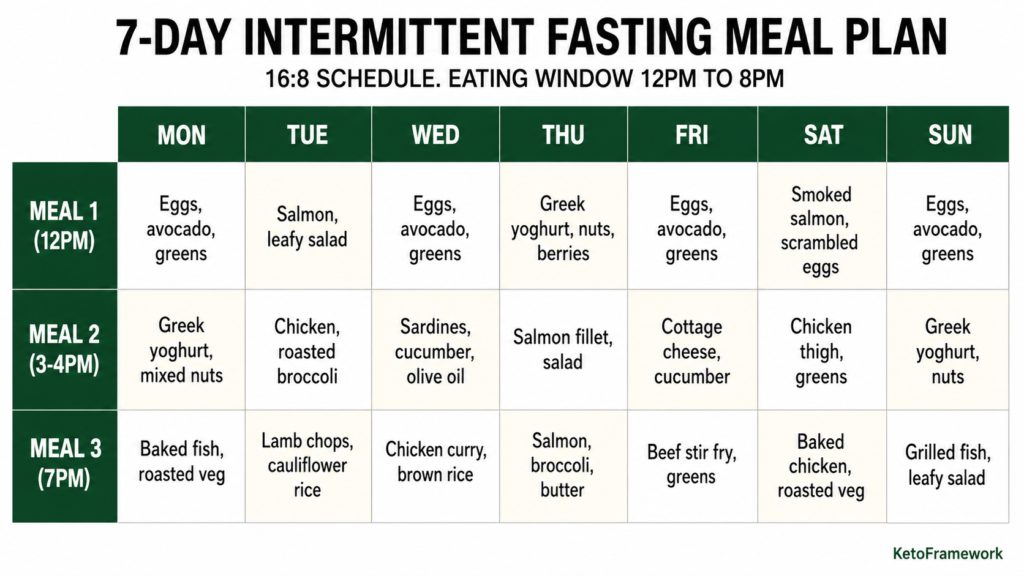
This is a practical 7-day IF weekly meal plan built on the four principles above. It is not calorie-counted because it does not need to be. It is protein-forward, whole food based, and uses simple, repeatable meals that rotate through the week.
Eating window: 12pm to 8pm. Fasting window: 8pm to 12pm (16 hours).
| Day | Meal 1 (12pm) | Meal 2 (3pm to 4pm) | Meal 3 (7pm) |
| Monday | 3 eggs in butter, half avocado, leafy greens with olive oil | Full-fat Greek yoghurt, mixed nuts | Baked salmon, roasted broccoli with butter, leafy salad |
| Tuesday | Salmon fillet, large leafy salad with olive oil dressing | Grilled chicken thigh, roasted vegetables | Lamb or beef with cauliflower rice and green beans |
| Wednesday | 3 eggs in butter, half avocado, leafy greens with olive oil | Sardines or tuna, cucumber slices, olive oil | Chicken and vegetable curry, small portion of brown rice |
| Thursday | Full-fat Greek yoghurt, mixed nuts, handful of berries | Salmon fillet, leafy salad, olive oil | Baked fish, steamed broccoli with butter, lemon |
| Friday | 3 eggs in butter, half avocado, leafy greens with olive oil | Cottage cheese, cucumber, handful of walnuts | Beef stir fry with leafy greens and sesame oil |
| Saturday | Smoked salmon, 2 to 3 scrambled eggs in butter, leafy greens | Grilled chicken thigh, roasted broccoli, olive oil | Baked chicken thighs, roasted mixed vegetables |
| Sunday | 3 eggs in butter, half avocado, leafy greens with olive oil | Full-fat Greek yoghurt, mixed nuts | Grilled fish, large leafy salad, olive oil and lemon |
Notes on the 7-day plan
• Meal 1 repeats often. That is deliberate. The eggs-avocado-greens first meal is consistently the best-performing first meal for insulin response, satiety, and ease of preparation. Rotating it occasionally with salmon or yoghurt keeps it varied without introducing complexity.
• Protein targets: every meal in this plan delivers 25 to 35 grams of protein. Total daily protein across three meals is 75 to 100 grams, adequate for most people at 70 to 90kg of body weight.
• Carbohydrates: this plan is low in refined carbohydrate. Brown rice and wholegrain bread appear once or twice in the week as secondary components of evening meals, not as the base. If you are also doing keto alongside IF, replace the brown rice with cauliflower rice and the bread with additional protein or fat.
• Family meals: the evening meal (Meal 3) is the most flexible. This is where my wife and I eat together as a family. Whatever is cooked that evening works within the plan as long as protein is present and refined carbohydrates are not the dominant component.
Adapting the IF Meal Plan to Your Preferences
The 7-day plan above is a template, not a prescription. Here is how to adapt it.
If you are combining IF with keto
Replace all grain-based carbohydrates with low-carbohydrate alternatives. Cauliflower rice instead of brown rice. Extra leafy greens or roasted vegetables instead of bread. Increase fat slightly, particularly at the first meal. The keto-IF combination is what my wife and I both follow. The four-principle meal structure applies identically: protein first, healthy fat at every meal, non-starchy vegetables as the base, minimal refined carbohydrate (essentially zero on keto).
If you have a shorter eating window (18:6, 12pm to 6pm)
Drop Meal 3 or move it earlier to 5pm to 6pm. On an 18:6 window, two proper meals work better than three for most people. Meal 1 becomes more substantial: 3 eggs plus salmon plus avocado plus greens. Meal 2 at 4pm to 5pm is the final meal, typically a protein-forward dinner equivalent. This is the structure my wife and I use. Two meals, both substantial, no snacking outside the window.
If you eat out or have social meals
The principles travel. At a restaurant, order protein as the main, add a side salad or vegetables, and avoid bread or pasta as the main base. Grilled fish, chicken, steak with vegetables: these all fit the IF food plan without requiring special requests. The eating window and fasting window remain unchanged around social meals.
If you are vegetarian
Replace animal protein sources with plant equivalents that deliver 25 to 30 grams per meal: full-fat Greek yoghurt, cottage cheese, eggs, tofu, tempeh, legumes combined with a quality protein source. The challenge with plant-based IF is that many high-protein plant foods (legumes, tofu, edamame) also contain carbohydrates that raise insulin more than animal proteins. Eggs and full-fat dairy are the cleanest plant-adjacent options for IF meal planning.
Frequently Asked Questions About the Intermittent Fasting Meal Plan
What should I eat on an IF meal plan for weight loss?
The IF meal plan for weight loss is built on protein first, healthy fats at every meal, non-starchy vegetables as the base, and minimal refined carbohydrates especially at the first meal. You do not need to count calories. The fasting window reduces appetite naturally. The eating window needs to be filled with protein-forward whole food meals that earn the metabolic work the fast has done. Eggs, avocado, salmon, chicken, leafy greens, full-fat dairy, nuts: these are the foods that make the eating window work.
How many meals should I eat on an IF meal plan?
On a 16:8 eating window of 12pm to 8pm, two to three meals work well. Three smaller to moderate meals at 12pm, 3pm to 4pm, and 7pm is the most common structure. On an 18:6 eating window of 12pm to 6pm, two meals is more practical: a substantial first meal at 12pm and a satisfying final meal at 5pm to 6pm. Do not skip meals within the eating window to restrict further. Eating too little during the window raises cortisol, increases the next fasting window difficulty, and makes the approach unsustainable.
Do I need to count calories on an IF meal plan?
No. Research confirms that people following a consistent IF schedule naturally reduce calorie intake by several hundred calories per day without deliberate counting. Eating protein-forward, whole food meals within the eating window produces the appetite regulation that makes deliberate calorie restriction unnecessary. The one exception is if you have been on IF consistently for two to three months, your eating window is clean, your schedule is consistent, and fat loss has stalled. In that case, a brief audit of portion sizes may help identify whether the eating window is inadvertently over-feeding.
Can I eat carbohydrates on an intermittent fasting meal plan?
Yes, particularly whole food carbohydrates later in the eating window. Refined carbohydrates, especially as the first meal of the eating window, are the main thing to avoid. Sweet potato, brown rice, oats, legumes, and wholegrain bread work reasonably well as secondary components of second or third meals within the eating window because they are eaten alongside protein and fat that moderate the insulin response. The key distinction is whole food carbohydrates in moderation later in the window versus refined carbohydrates as the opening meal.
What if I am not hungry for three meals in the eating window?
This is a normal and positive sign of hormonal adaptation. As IF practice becomes consistent, the appetite regulation benefit means many people find they can only comfortably eat two meals within the eating window rather than three. If you are genuinely not hungry for a third meal, do not force it. Two protein-forward meals totalling 70 to 100 grams of protein is adequate for most people and is exactly the pattern my wife and I naturally settled into. The eating window is not a time to eat as much as possible. It is a time to eat well and adequately.
How long before my IF meal plan produces results?
Visible results from a consistent IF meal plan built on the four principles above typically appear in weeks four to six for most people. The first results are appetite changes: reduced morning hunger and more stable energy through the eating window. Measurable fat loss follows from weeks three to four. Significant body composition change is measurable at eight to twelve weeks. Consistency in both the fasting schedule and the eating window food quality determines the speed of results more than any other variable.
Intermittent Fasting Meal Plan: The Simple Version
The IF meal plan for weight loss does not need to be complicated. It needs to be consistent.
Protein and fat at the first meal. Protein and fat at every meal after that. Non-starchy vegetables at every meal. Refined carbohydrates minimised, especially early in the eating window. Two or three proper meals within the window. The fasting window runs itself.
That is the complete IF food plan. Four principles applied to two or three meals within the eating window, repeated consistently across the week. No calorie counting. No complicated recipes. No different meal every day.
My wife and I have both been eating this way for over a year. The meals are largely the same from week to week because they work, they are quick to prepare, and we are both satisfied by them. The results have been sustained because the approach is sustainable.
Start with the 7-day plan above. Cook the meals you recognise and are comfortable making. Rotate as you build confidence with the eating window. The principles stay constant even when the specific meals change.
The complete framework including fasting schedules, method comparisons, and the science behind how IF produces results is in the intermittent fasting diet plan. For the specific question of how to open the eating window correctly, the guide on how to break a fast covers the first meal in full. And for understanding exactly what the fasting window is doing while this meal plan is running, the guide on what is intermittent fasting covers the full biology.
References
1. Leidy HJ, Clifton PM, Astrup A, et al. The role of protein in weight loss and maintenance. American Journal of Clinical Nutrition, 2015. https://pubmed.ncbi.nlm.nih.gov/25926512/
2. Cioffi I, Evangelista A, Ponzo V, et al. Intermittent versus continuous energy restriction on weight loss and cardiometabolic outcomes: a systematic review and meta-analysis of randomized controlled trials. PMC, Journal of Translational Medicine, 2018. https://pmc.ncbi.nlm.nih.gov/articles/PMC6304782/
3. Huang T, Zheng Y, Li J, et al. Is time-restricted eating (8/16) beneficial for body weight and metabolism of obese and overweight adults? A systematic review and meta-analysis of randomized controlled trials. PMC, Food Science and Nutrition, 2023. https://www.ncbi.nlm.nih.gov/pmc/articles/PMC10002957/