
One of the most common questions I get asked about intermittent fasting is also the most practically important one: how long should you fast?
It is a better question than it might seem. The answer is not one number. It depends on what you are trying to achieve, how long you have been fasting, and what your daily life actually looks like. A 16-hour fasting window produces different results to a 14-hour window. An 18-hour window produces different results again. And the window that is optimal for someone three months into fasting is not the right starting point for someone on day one.
My wife and I both started at 14:10. We both ended up at 18:6 after about six weeks. Neither of us arrived there because we planned to. We got there because each window became comfortable enough that extending it felt natural rather than forced. That progression is what this article is about. The full intermittent fasting framework including meal plans and method comparisons is in the intermittent fasting diet plan. If you are completely new to fasting, the intermittent fasting for beginners guide covers where to start. This article is specifically about fasting windows: how many hours to fast, what each window produces, and how to find the one that fits your goals and your life.
How Long Should You Fast: What the Research Actually Shows
Before getting into which window is right for you, it helps to understand what the research actually shows about fasting duration and results. Not what is claimed on social media, but what peer-reviewed studies have found when they measured real outcomes in real people.
The short version is this: somewhere between 14 and 18 hours of daily fasting is where most of the documented benefits sit. Below 12 hours you are unlikely to see meaningful metabolic change. Beyond 20 hours you are in territory where the research is thin and the practical difficulty increases significantly. The sweet spot for most people, and the one with the most evidence behind it, is 16 hours.
A 2018 study published in PubMed (Gabel et al., Nutrition and Healthy Aging, 2018)[1] studied 16:8 time-restricted feeding in 23 obese adults over 12 weeks. Participants eating only between 10am and 6pm lost an average of 2.6 percent of their body weight and reduced their daily calorie intake by around 340 calories, without any calorie counting at all. Blood pressure also improved.
A second study published in PMC (Moro et al., Journal of Translational Medicine, 2016)[2] looked at 16:8 in a completely different population: resistance-trained males. Over eight weeks, the 16:8 group decreased fat mass and saw improvements in inflammatory markers and cardiovascular risk factors, while maintaining muscle mass. The finding that a 16-hour fast can reduce fat without losing muscle is particularly relevant for anyone who trains.
What both studies confirm is not that 16:8 is the only window that works. It is that 16 hours of fasting is enough to produce the sustained low-insulin state that drives fat oxidation, metabolic improvement, and appetite regulation. The question of how many hours to fast then becomes more specific: how many hours is enough for your goal, and how many hours is too many for your lifestyle?
How Many Hours to Fast: The Window by Window Breakdown
The question of how many hours to fast does not have one answer. It has several, depending on your goal. Here is what each major fasting window produces, and who it is right for.
12 hours: the baseline
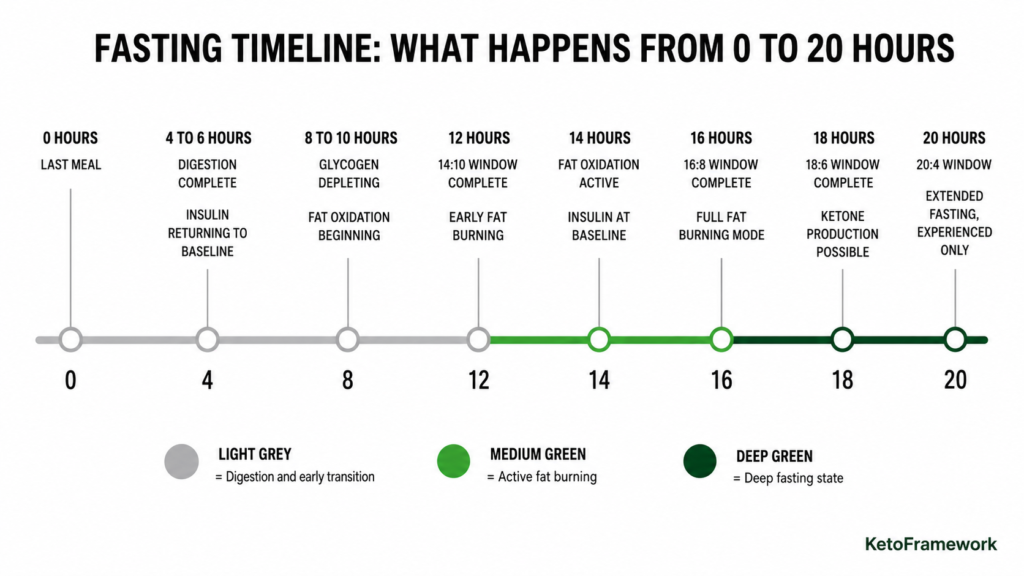
A 12-hour fast is roughly what most people already do overnight without thinking about it. Finishing dinner at 8pm and eating breakfast at 8am. Twelve hours gives insulin time to return to baseline after the last meal, but it does not sustain a low-insulin state for long enough to produce significant fat oxidation. You are essentially resetting your metabolic state overnight rather than actively burning stored fat. A 12-hour fast is not a meaningful intermittent fasting protocol. It is the floor you are already standing on.
14:10: the starting point
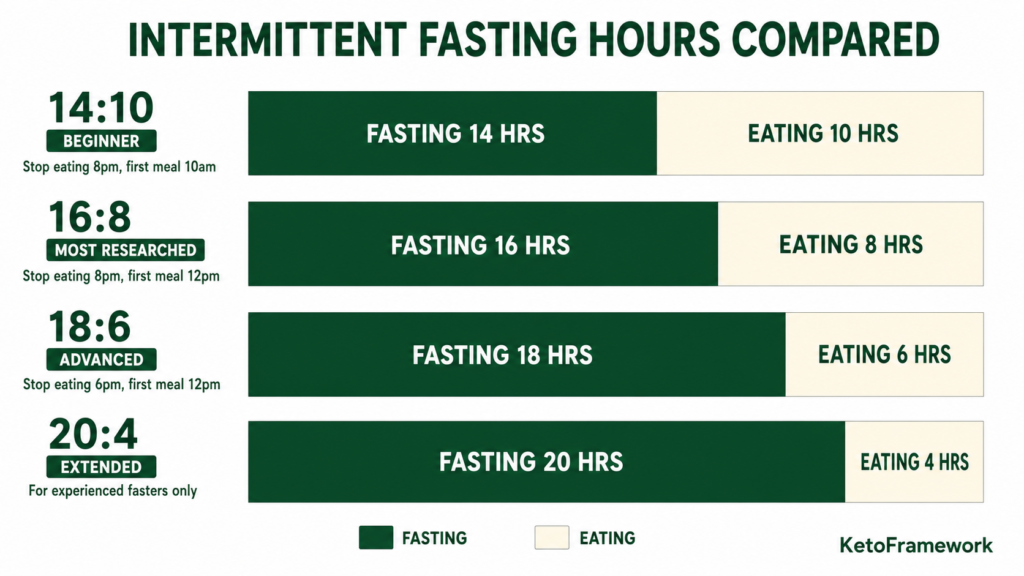
A 14-hour fasting window with a 10-hour eating window. Stop eating at 8pm, first meal at 10am. This is the right starting point for every beginner without exception. It extends the overnight fast by about two hours from each end, produces real but gentle hormonal adaptation, and is manageable from day one for most people. My wife and I both started here. At 14 hours your body has cleared digestion, insulin has been at baseline for several hours, and fat oxidation is beginning. You are not yet in sustained fat-burning mode, but you are building the daily fasting habit that makes 16:8 accessible within two to three weeks.
16:8: the best fasting window for weight loss and general health
A 16-hour fasting window with an 8-hour eating window. Stop eating at 8pm, first meal at 12pm. This is the most researched intermittent fasting protocol and the one with the strongest evidence base for weight loss, insulin improvement, and metabolic health. It is the best fasting window for weight loss for most people. At 16 hours, insulin has been low for a sustained period and fat oxidation is running at a meaningful rate. The body is actively drawing on stored fat for fuel. For most people this is also the window where the appetite changes become noticeable: the morning hunger that dominated the first week of fasting has largely disappeared by week two of 16:8, replaced by stable energy through the late morning.
18:6: the optimal fasting duration for experienced fasters
An 18-hour fasting window with a 6-hour eating window. Stop eating at 6pm or 7pm, first meal at 12pm or 1pm. This is where both my wife and I settled after about six weeks of 16:8, not because we planned to, but because 18:6 stopped feeling difficult. The eating window of 12pm to 6pm or 1pm to 7pm becomes natural. At 18 hours, fat oxidation is running strongly and some people begin producing measurable ketones even without a ketogenic diet. The appetite suppression at this window is noticeably stronger than at 16:8 for most people who have been fasting consistently. For anyone already comfortable with 16:8, 18:6 is worth trying if extending the window happens naturally. It should never be forced.
20:4: extended fasting, not recommended for beginners
A 20-hour fasting window with a 4-hour eating window. This is significantly more demanding than 18:6 and moves into territory where research is thinner. A study published in PMC (Cienfuegos et al., Cell Metabolism, 2020)[3] found that a 4-hour eating window and a 6-hour eating window produced comparable results, with both groups losing around 3 percent of body weight and reducing insulin resistance significantly. In other words, going from 6 hours of eating to 4 hours does not appear to produce meaningfully better outcomes. If you are already doing 18:6, the evidence does not suggest that pushing to 20:4 gives you proportionally more benefit. For most people, 18:6 is where the returns plateau and the difficulty begins to outweigh the gain.
The Best Fasting Window for Weight Loss: What Actually Drives Results

When people ask how long should you fast for weight loss, they often assume the answer is simply: longer is better. The research does not support this cleanly. What drives results is not the length of the fasting window alone. It is the consistency of the fasting window combined with the quality of what you eat during the eating window.
Here is what actually drives results from a fasting window, in order of importance.
Consistency matters more than duration
A 14-hour fast done every day for eight weeks produces more measurable change than a 16-hour fast done three days a week with irregular eating on the other four. The metabolic adaptation that makes fasting work, the hormonal recalibration that reduces morning hunger, stabilises energy, and improves insulin sensitivity, requires consistent daily practice. It is not built in a single long fast. It is built through repetition.
The minimum effective window is roughly 14 to 16 hours
Below 12 hours, the low-insulin state is too brief to produce significant fat oxidation. Between 12 and 14 hours, you are in a transition zone. At 14 hours, fat burning is beginning but not yet sustained. At 16 hours, based on the available research, you are in the window where the metabolic benefits are reliably measurable. This is why 16:8 is the best fasting window for weight loss as a general recommendation: it is the shortest window at which the evidence is consistently strong.
Longer windows have diminishing returns past 18 hours
The jump from 14 to 16 hours produces meaningful change. The jump from 16 to 18 hours extends the fat-burning period and can strengthen appetite suppression. The jump from 18 to 20 hours, as the Cienfuegos study found, does not appear to produce proportionally greater weight loss or metabolic improvement. Beyond a certain point, extending the fasting window adds difficulty without adding proportional benefit.
What you eat during the eating window matters significantly
A 16-hour fast followed by 8 hours of refined carbohydrates and processed food will not produce the same results as a 16-hour fast followed by 8 hours of protein-forward, whole food eating. The fasting window lowers insulin. The eating window determines what insulin rises in response to. Breaking the fast with eggs and avocado produces a moderate insulin response and maintains satiety for three to four hours. Breaking it with cereal and juice produces a large insulin spike that partially counteracts the metabolic work of the fasting period. The fasting window creates the conditions. The eating window determines how well you use them.
Fasting Window Guide: Matching the Window to Your Goal
The right fasting window is not the longest one you can manage. It is the one that matches your goal and that you can maintain consistently. Here is how to match the window to the outcome you are looking for.
| Goal | Recommended Window | Why |
| Starting out for the first time | 14:10 | Builds the fasting habit without significant discomfort. Produces early adaptation that makes 16:8 accessible within two to three weeks. |
| General health and steady fat loss | 16:8 | The most researched window. Produces consistent fat loss, improved insulin sensitivity, and appetite regulation for most people. |
| Accelerating fat loss after adapting to 16:8 | 18:6 | Extends the fat-burning period meaningfully. Best approached after four to six weeks of consistent 16:8. |
| Combining IF with keto | 16:8 or 18:6 | Keto already lowers insulin through carbohydrate restriction. The combination with a 16 to 18 hour window produces faster ketosis and stronger appetite suppression than either alone. |
| Maintaining results long term | 16:8 or 18:6, whichever is sustainable | The best long-term fasting window is the one you can maintain without effort. 16:8 maintained consistently produces better long-term outcomes than 18:6 abandoned. |
| Weight loss with regular exercise or training | 16:8 | The Moro 2016 study found that 16:8 in resistance-trained males decreased fat mass while maintaining muscle mass. Protein intake during the eating window is critical. |
How to Find Your Optimal Fasting Duration
There is no universal optimal fasting duration. There is the window that is optimal for you right now, based on how long you have been fasting, your current lifestyle, and what you are trying to achieve. Here is a practical way to find it.
Start at 14:10 and measure adaptation, not just weight
In your first two weeks of 14:10, the number on the scale is not the most useful signal. The useful signal is your morning hunger. Are you still fighting strong hunger during the fasting window by day five? By day ten? If morning hunger has largely resolved by day ten, you are adapted and ready to consider extending to 16:8. If it has not, stay at 14:10 for another week. The hunger resolution is the signal that your hunger hormones have recalibrated to the new pattern. Extending before that recalibration is complete is what makes the next window unnecessarily hard.
Move to 16:8 by extending one hour at a time
When 14:10 feels natural, push your first meal back by one hour to 11am. Hold there for three to four days. Then push to 12pm. You are now at 16:8 without a single dramatically difficult day. This is exactly how my wife and I both moved from 14:10 to 16:8. One hour at a time, each extension triggered by comfort with the current window rather than impatience with the result.
Consider 18:6 only after four to six weeks of consistent 16:8
If 16:8 has become genuinely comfortable and you want to extend the fat-burning window further, try 18:6 by pushing dinner earlier. Close the eating window at 6pm or 7pm instead of 8pm. For most people who have been consistent at 16:8, this adjustment is smaller than the original jump from 14:10 to 16:8. My wife found it barely noticeable after six weeks at 16:8. My experience was similar.
Do not extend based on impatience with results
The most common mistake in choosing a fasting window is extending it because you want faster results rather than because the current window feels easy. Jumping from 14:10 to 18:6 in week one bypasses the hormonal adaptation that makes each window sustainable. The research shows that 16:8 consistently maintained for eight to twelve weeks produces strong, measurable results. The window is not the bottleneck. Consistency is.
Frequently Asked Questions About How Long to Fast
How long should you fast as a complete beginner?
How long should you fast as a beginner is a simpler answer than most people expect: 14 hours. Stop eating at 8pm and have your first meal at 10am. Do not start with 16:8 or 18:6. The adaptation your body needs to make, particularly in the hunger hormone ghrelin, takes five to seven days and is significantly more manageable at 14:10 than at a longer window. Two weeks of consistent 14:10 will prepare you for 16:8 more effectively than jumping straight to 16:8 on day one.
What is the best fasting window for weight loss?
The best fasting window for weight loss for most people is 16:8. The research on this window is the most robust, and the practical experience of most consistent IF practitioners points to the same conclusion. Sixteen hours is long enough to produce a sustained low-insulin state that drives meaningful fat oxidation. It is short enough that the eating window of eight hours is practical for daily life, family meals, and social eating. If you have been doing 16:8 consistently for four to six weeks and want to extend further, 18:6 is the natural next step.
Is 14 hours enough fasting to see results?
Fourteen hours of fasting does produce fat oxidation and metabolic benefit, but the effect is less strong than at 16 hours because the sustained low-insulin period is shorter. For complete beginners, 14:10 is the right starting point and does produce real adaptation and early results. As an ongoing protocol for someone who has been fasting for several months, 14:10 is on the lighter end. Think of it as the foundation rather than the destination.
Does a longer fasting window always produce better results?
No. The evidence from the Cienfuegos 2020 study comparing 4-hour and 6-hour eating windows found comparable outcomes between the two, suggesting that at a certain point extending the fasting window further does not produce proportionally better results. The meaningful jumps in outcome occur moving from under 12 hours to 14 hours, and from 14 hours to 16 hours. Beyond 18 hours the additional benefit appears to level off for most people while the difficulty of maintaining the window increases. The optimal fasting duration is the longest window you can maintain consistently and comfortably, not the longest window you can endure.
How long should I fast if I am combining IF with keto?
If you are combining intermittent fasting with keto, 16:8 is the natural starting point and often the only window you need. Keto already lowers insulin through carbohydrate restriction. The combination of keto and a 16-hour fasting window produces faster entry into ketosis, stronger appetite suppression, and more reliable fat oxidation than either approach alone. Some people doing keto and IF move naturally to 18:6 after a few weeks because appetite suppression is so strong that eating earlier simply does not appeal. Let the appetite lead rather than setting a target window and forcing it.
Can I fast for too long?
Yes. Daily fasting windows beyond 20 hours carry increasing risk of muscle loss, cortisol elevation, and micronutrient deficiency without proportional metabolic benefit over more moderate windows. Fasting periods of 24 hours and beyond should only be attempted by experienced fasters and ideally with guidance from a healthcare provider. For daily practice, the 14 to 18 hour range covers the full spectrum of evidence-supported benefit for most healthy adults.

How Long Should You Fast: The Simple Answer
How long should you fast? Start at 14 hours. Move to 16 when 14 feels easy. Consider 18 when 16 has been consistent for four to six weeks. Stop there unless extending happens naturally.
That is the complete fasting window guide in four sentences. Everything else in this article is context that helps you understand why those numbers work and how to move between them without making the process harder than it needs to be.
What I learned from my own experience, and from watching my wife go through the same progression, is that the right fasting window is not the one that sounds most impressive. It is the one that has become invisible. When you stop thinking about your fasting window because it just runs as part of your day, that is the window that is working for you.
The complete intermittent fasting framework with meal plans and schedule comparisons is in the intermittent fasting diet plan. For understanding the biology behind why the fasting window produces results, the guide on what is intermittent fasting covers the full mechanism. And for starting from the beginning with a day-by-day approach, the intermittent fasting for beginners guide is where to go first.
References
All sources cited in this article are peer-reviewed studies sourced from PubMed or PMC. This article is for informational purposes and does not constitute medical advice. If you have an existing health condition, are pregnant or breastfeeding, or take medication requiring food intake, consult your doctor before starting intermittent fasting.
1. Gabel K, Hoddy KK, Haggerty N, Song J, Kroeger CM, Trepanowski JF, Panda S, Varady KA. Effects of 8-hour time restricted feeding on body weight and metabolic disease risk factors in obese adults: a pilot study. PubMed, Nutrition and Healthy Aging, 2018. https://pubmed.ncbi.nlm.nih.gov/29951594/
2. Moro T, Tinsley G, Bianco A, et al. Effects of eight weeks of time-restricted feeding (16/8) on basal metabolism, maximal strength, body composition, inflammation, and cardiovascular risk factors in resistance-trained males. PMC, Journal of Translational Medicine, 2016. https://www.ncbi.nlm.nih.gov/pmc/articles/PMC5064803/3. Cienfuegos S, Gabel K, Kalam F, et al. Effects of 4- and 6-h time-restricted feeding on weight and cardiometabolic health: a randomized controlled trial in adults with obesity. PMC, Cell Metabolism, 2020. https://pmc.ncbi.nlm.nih.gov/articles/PMC9407646/