
The most important thing I can tell you about intermittent fasting results before you start is this: the first result is not weight loss.
Most people begin intermittent fasting because they want to lose weight. That is a completely reasonable goal and IF produces it reliably. But the first measurable change from a consistent fasting practice is not a number on a scale. It is a change in how hungry you are in the morning.
That shift, from constant background hunger to genuine absence of appetite during the fasting window, typically arrives between day five and day ten of consistent IF. It arrives before any meaningful fat loss. It arrives before visible changes in the body. And when it arrives, it tells you that something real has changed in your hormonal environment. The mechanism is working. The results will follow.
This article is a realistic, research-backed account of what intermittent fasting results actually look like, week by week and month by month. What changes first, what changes later, how much weight loss is realistic, and what my wife and I both experienced when we went through this process.
For the full framework that produces these results, the intermittent fasting diet plan covers every method and schedule. For the schedule that drives the timeline below, the intermittent fasting schedule guide has the practical structure.
Why Realistic Expectations Matter More Than Ambitious Ones
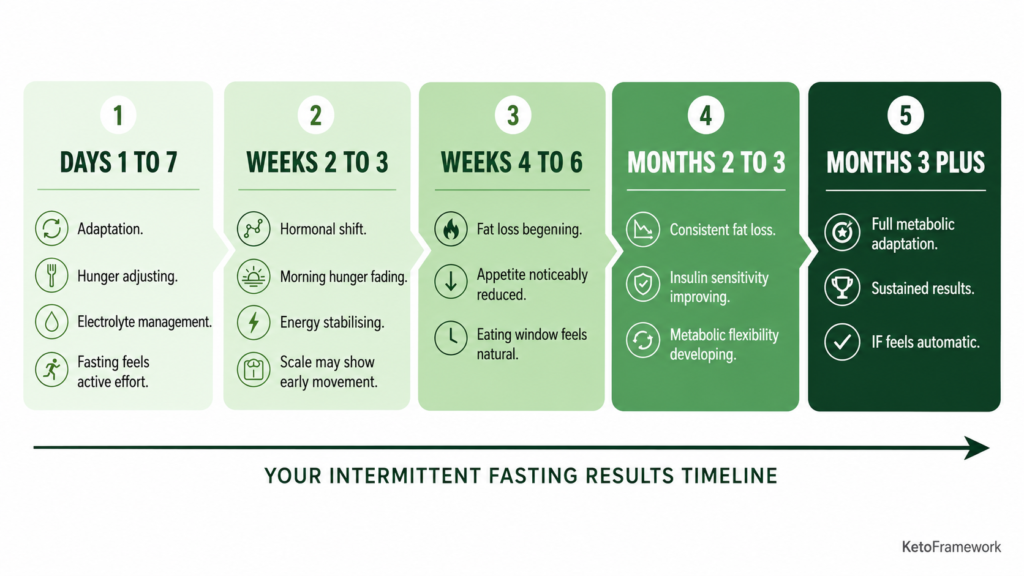
Most of the disappointment people experience with intermittent fasting comes from expecting the wrong results at the wrong time. They start IF expecting to see significant weight loss within a week. When the scale barely moves, or moves and then bounces back, they conclude it is not working and quit, usually right before the results they were actually chasing would have arrived.
The research on IF results is consistent on this point. A meta-analysis published in PMC (Harris et al., JBI Database of Systematic Reviews, 2018)[1] that compared alternate day fasting, 5:2, and time-restricted eating across multiple randomised controlled trials found that meaningful, consistent weight loss from IF protocols typically develops over eight to twenty-four weeks, not one to two weeks. Studies that only run for four weeks or less tend to show smaller, more variable results, while those running twelve weeks or more show consistent fat loss and metabolic improvement across virtually all participants.
The reason for this timeline is not that IF is slow. It is that IF works through hormonal adaptation, and hormonal adaptation takes time. You are not cutting calories on a spreadsheet. You are changing the hormonal environment your body operates in. That change is real, measurable, and durable, but it builds across weeks, not days.
Set your expectations to the right timeline and IF becomes one of the most reliable dietary approaches available. Set them to a week, and you will quit before anything meaningful has happened.
Intermittent Fasting Results Week by Week: The Honest Breakdown
Days 1 to 7: the adaptation phase
The first week of intermittent fasting is not about results. It is about adaptation. Your hunger hormone ghrelin is trained to expect food at the times you usually eat. When you stop eating in the morning as part of a 14:10 or 16:8 schedule, ghrelin rises at your old breakfast time and produces real, uncomfortable hunger. This is not your body telling you the approach is wrong. It is your body running an old programme that is about to be updated.
What most people experience in week one:
• Days 1 to 2: The change is small. A 14:10 schedule extending breakfast by two hours is manageable. Mild hunger in the late morning. Energy largely normal.
• Days 3 to 4: Often the hardest days. Hunger is stronger in the morning. Some people experience mild headaches or low energy. This is primarily electrolyte depletion from increased sodium excretion during the fasting window. A pinch of sea salt in water each morning resolves most of it.
• Days 5 to 7: The hunger begins to ease noticeably. Not gone yet, but reduced. For many people the difference between day three and day seven is dramatic. This is ghrelin beginning to recalibrate to the new eating pattern.
Scale movement in week one: you will likely see a reduction of one to two kilograms, sometimes more. Almost all of this is water. As insulin falls and glycogen is partially depleted during the fasting windows, the body releases water that was bound to glycogen stores. This is real, visible, and encouraging. It is not primarily fat loss. Do not use week-one scale numbers as your benchmark for the approach. For a day-by-day breakdown of the first week, the intermittent fasting for beginners guide covers every day in detail.
Weeks 2 to 3: the hormonal shift
This is where intermittent fasting starts to feel different in a way that is genuinely surprising for most people. The morning hunger that dominated week one continues to fade. By the end of week two, many people report that they are simply not hungry in the morning in the way they used to be. My wife noticed this clearly around day ten. For me it was closer to day twelve. It is not a gradual fading. It tends to feel like one morning you wake up and realise the fight has gone quiet.
This change is a hormonal event, not a willpower achievement. Ghrelin has adapted its rhythm to the new eating schedule. The insulin spikes that were driving background hunger throughout the day have reduced. The body is beginning to access stored fat for fuel during the fasting window rather than urgently demanding more food.
What changes in weeks 2 to 3:
• Appetite in the morning is noticeably reduced or largely absent. This is the most significant early result of IF and the one that makes everything else sustainable.
• Energy becomes more stable through the late morning. The energy crashes that many people experience mid-morning on a standard eating pattern begin to reduce as blood sugar regulation improves.
• Scale movement continues, though more slowly than week one. True fat loss is beginning but is modest at this stage. Expect roughly 0.5 to 1 kilogram of genuine fat loss across weeks two and three combined if you are eating properly during the eating window.
Weeks 4 to 6: fat loss accelerating
By week four, intermittent fasting is no longer effortful for most people. The eating window from 12pm to 8pm on a 16:8 schedule has become the default. The fasting window runs mostly through sleep and morning work hours where distraction and black coffee keep hunger low. The metabolic change that the first three weeks were building is now producing measurable results.
A controlled feeding trial published in PubMed (Sutton et al., Cell Metabolism, 2018)[2] demonstrated that even after just five weeks of consistent time-restricted eating, participants showed measurable improvements in insulin sensitivity, blood pressure, and oxidative stress independently of weight loss. This is important because it means the metabolic changes begin before significant weight loss is visible. You may not have lost a large amount of weight by week five, but your insulin sensitivity is improving, your blood pressure may be lowering, and your body’s ability to manage blood glucose is getting better.
Visible changes most people notice in weeks 4 to 6:
• Clothes fitting differently, particularly around the midsection. Visceral fat tends to respond earlier to IF than overall scale weight suggests.
• Reduced afternoon snacking urge. The appetite regulation benefit of consistent fasting is beginning to show up in the eating window, not just during the fast.
• Fewer food thoughts throughout the day. The constant background noise of thinking about food, the next meal, afternoon hunger, reduces significantly for most consistent IF practitioners by week four to six.
Months 2 to 3: consistent, measurable fat loss
This is where the results most people started IF for arrive in full. The metabolic adaptation is complete. The fasting window runs automatically. The eating window produces two or three satisfying meals without excessive hunger or calorie counting. And the scale is moving consistently.
How much weight can you lose with intermittent fasting at this stage? A randomised controlled trial published in PMC (Cienfuegos et al., Cell Metabolism, 2020)[3] found that participants following short eating windows over eight weeks lost approximately 3 percent of body weight without any deliberate calorie restriction. For a person starting at 80kg, that is 2.4kg over eight weeks. For someone starting at 100kg, that is 3kg. These are conservative figures from a controlled trial. Real-world results with consistent IF and good food quality during the eating window are often higher.
My wife lost 5kg in total over approximately twelve weeks of consistent IF combined with keto. I lost my belly fat and measurably changed my body composition over a similar period. Neither of us counted calories.
Month 3 and beyond: full adaptation and sustained results
By month three, something has permanently changed. Not just the weight or the waist measurement. The relationship with food. The constant low-level preoccupation with eating that characterised life before IF has been replaced by a genuinely different experience: you eat when it is time to eat, you are satisfied by what you eat, and you do not think much about food outside those times.
This is metabolic flexibility in practice. Your body can switch between glucose and fat as fuel sources efficiently. Your insulin sensitivity has improved. Your hunger hormones are calibrated to your schedule rather than driving you toward food at random times.
Long-term IF practitioners consistently report that the approach becomes self-reinforcing at this stage. The results are visible enough to motivate continuation. The process is automatic enough that continuation requires minimal effort.
IF Weight Loss Results: What the Research Says and What Is Realistic
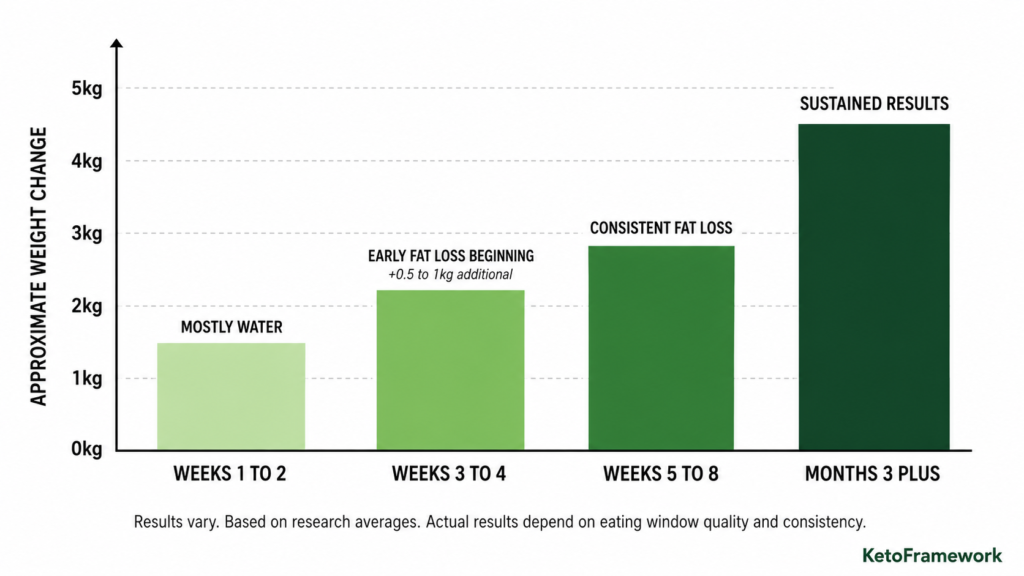
The question of how much weight can you lose with intermittent fasting is one of the most searched IF questions, and the honest answer is: less than the most enthusiastic claims, and more than the most sceptical ones, over a realistic timeframe.
What the research shows
The best-quality RCT data on IF weight loss shows consistent but moderate results over 8 to 24 weeks. The figures that come up repeatedly across well-designed studies are in the range of 2 to 5 percent of starting body weight over 8 to 12 weeks without deliberate calorie restriction. For most people, that translates to 2 to 5 kilograms of genuine fat loss over 8 to 12 weeks.
These are averages across mixed populations. Individual results vary substantially depending on starting weight, food quality during the eating window, whether IF is combined with dietary changes such as reduced refined carbohydrate intake, physical activity levels, and how consistently the schedule is maintained.
What inflates the numbers you see online
Intermittent fasting before and after stories circulate widely on social media, and many of them show dramatic transformations in short timeframes. What is almost always missing from these stories is that the person did not only do IF. They typically also changed what they ate, often significantly, increased physical activity, and in many cases combined IF with a ketogenic or low-carbohydrate diet.
IF combined with keto is meaningfully more effective for fat loss than either approach alone, because both lower insulin through different mechanisms. My wife and I both combined them. Our results, 5kg for her and significant body composition change for me, reflect that combination, not IF alone on a standard diet.
What determines whether your results are on the higher or lower end
The eating window is where most of the variation in IF results comes from. Two people following identical 16:8 schedules can have very different results if one person uses the eating window to eat protein-forward, whole food meals and the other breaks the fast with high-carbohydrate processed food. The schedule creates the conditions. The eating window determines how effectively those conditions are used.
Consistency of the schedule is the second major variable. A perfect IF schedule held five days a week produces significantly less adaptation and less fat loss than the same schedule held consistently seven days a week including weekends.
Intermittent Fasting Before and After: What Actually Changes
Weight loss is the most visible IF result but it is not necessarily the most significant one. Here is the full picture of what changes with consistent IF practice.
The changes that arrive first (weeks 1 to 3)
• Reduced morning hunger. As discussed throughout this article, this is the first and most reliable early result of consistent IF. It precedes visible fat loss by one to two weeks.
• More stable morning energy. The energy crash that many people experience mid-morning on a standard eating pattern begins to reduce as blood sugar regulation improves.
• Reduced afternoon snacking urge. The appetite regulation benefit appears in the eating window, not just during the fast, within the first few weeks.
The changes that arrive mid-term (weeks 4 to 12)
• Visible fat loss, particularly visceral fat around the midsection. This is the most commonly reported IF before and after change and it is well supported by the research.
• Improved insulin sensitivity. As demonstrated by Sutton et al. 2018, these improvements begin within five weeks and develop further with continued practice.
• Reduced inflammatory markers. Research consistently shows reductions in CRP and other inflammatory markers with sustained IF over eight to twelve weeks.
• Improved blood pressure. Multiple studies report blood pressure reductions with consistent TRE, particularly in people with elevated baseline readings.
The changes that arrive long-term (months 3 plus)
• Metabolic flexibility, the body’s ability to switch efficiently between glucose and fat as fuel sources. This develops over months of consistent practice and is associated with stable energy, reduced food preoccupation, and sustained fat loss maintenance.
• Changed relationship with food. This is the result most long-term IF practitioners describe as the most profound and least expected. You stop thinking about food constantly. You eat because you are genuinely hungry, not because of habit, boredom, blood sugar fluctuation, or stress.
• Sustained weight management without ongoing restriction. The most valuable long-term IF result is not the weight lost during the practice. It is the new hormonal baseline that makes maintaining that weight loss easier than it was before.
Frequently Asked Questions About Intermittent Fasting Results
How quickly do you see intermittent fasting results?
The first results from intermittent fasting are typically felt rather than seen. Reduced morning hunger usually appears between day five and day ten of consistent IF. This is a hormonal change, not a weight change, and it is the most reliable early signal that the approach is working. Visible changes on the scale begin in week one, but most of that is water. Genuine fat loss that is visible in how clothes fit typically becomes apparent in weeks four to six of consistent IF. Significant body composition changes are measurable at eight to twelve weeks.
How much weight can you lose with intermittent fasting in a month?
In the first month of consistent intermittent fasting, realistic fat loss is in the range of 1 to 2.5 kilograms of genuine fat, plus the initial water reduction of 1 to 2 kilograms in week one. Total scale movement in month one is often 2 to 4 kilograms. Results vary significantly based on starting weight, eating window food quality, whether IF is combined with dietary changes, and how consistently the schedule is held. People who also reduce refined carbohydrates or adopt a ketogenic diet alongside IF typically see higher results in month one.
What does intermittent fasting before and after look like at 3 months?
At three months of consistent IF, most people report visible fat loss particularly around the midsection, measurably improved energy and appetite stability, significantly reduced food preoccupation, and in many cases improved metabolic markers including blood pressure, fasting glucose, and cholesterol. The physical change is real and visible. The internal change in how hunger and energy feel is often described as equally significant. By month three the fasting window is largely automatic and the eating window is self-regulating.
Why am I not seeing intermittent fasting results after two weeks?
Two weeks is not long enough to see significant fat loss from IF. If you are two weeks in and discouraged, check three things. First, is the morning hunger reducing? If yes, the hormonal adaptation is happening on schedule and fat loss will follow. If no, check your electrolytes and whether anything is breaking the fast inadvertently, milk in coffee being the most common culprit. Second, is the eating window clean? Breaking the fast consistently with high-carbohydrate food blunts the metabolic benefit of the fasting window. Third, is the schedule consistent including weekends? Weekday-only IF produces significantly less adaptation than seven-day consistency. Two weeks with all three of these in order means results are coming. Give it to week six before forming any conclusion.
Do intermittent fasting results last?
Yes, when IF becomes a sustainable long-term practice rather than a short-term intervention. The weight loss produced by IF is maintained more effectively than diet-only approaches for most people because IF changes the hormonal environment rather than just restricting calories. Calorie restriction raises ghrelin over time, increasing hunger and making maintenance difficult. IF, when practiced consistently, actually reduces ghrelin’s disruptive influence on appetite by recalibrating hunger hormone timing. The maintenance challenge is not metabolic. It is behavioural: keeping the schedule consistent after reaching the goal rather than returning to an unstructured eating pattern.
Does combining IF with keto improve results?
Significantly. Keto lowers insulin by removing carbohydrates. IF lowers insulin by extending the gap between meals. Combined, they produce faster entry into ketosis, stronger appetite suppression, and more reliable fat loss than either approach alone. My wife and I both combined them and our results reflect that combination. For someone new to both, the recommendation is to establish one first, either IF or keto, for two to four weeks before adding the second. The adaptation curve for each is real and doing both simultaneously from day one is harder than starting sequentially.

Intermittent Fasting Results: The Honest Summary
Intermittent fasting produces real results. The timeline is weeks to months, not days. The first result is a hormonal shift in appetite that you feel before you see anything. The visible results in fat loss and body composition follow from weeks four to twelve of consistent practice. The long-term results in metabolic health, insulin sensitivity, stable energy, and changed relationship with food, develop over months and become self-sustaining.
What my wife and I both found is that the results exceeded what we expected precisely because we started with realistic expectations. We were not looking for dramatic week-one transformation. We were looking for a sustainable change in how our bodies worked. That is what IF delivered, and it has continued to deliver it because the practice has become automatic rather than effortful.
Set the right timeline. Manage your electrolytes. Protect your eating window quality. Hold the schedule consistently including weekends. Give it twelve weeks before drawing any conclusions.
The complete framework for every IF method, schedule, and meal structure is in the intermittent fasting diet plan. For the specific schedules that produce these results, the intermittent fasting schedule guide has the practical structure. And for understanding exactly what is happening biologically during the fasting window that creates these changes, the guide on what is intermittent fasting covers the full mechanism.
References
All sources cited in this article are peer-reviewed studies sourced from PubMed or PMC. This article is for informational purposes and does not constitute medical advice. If you have an existing health condition, are pregnant or breastfeeding, or take medication requiring food intake, consult your doctor before starting intermittent fasting.
1. Harris L, Hamilton S, Azevedo LB, et al. Intermittent fasting interventions for treatment of overweight and obesity in adults: a systematic review and meta-analysis. PMC, JBI Database of Systematic Reviews and Implementation Reports, 2018. https://pmc.ncbi.nlm.nih.gov/articles/PMC10098946/
2. Sutton EF, Beyl R, Early KS, Cefalu WT, Ravussin E, Peterson CM. Early time-restricted feeding improves insulin sensitivity, blood pressure, and oxidative stress even without weight loss in men with prediabetes. PubMed, Cell Metabolism, 2018. https://pubmed.ncbi.nlm.nih.gov/29754952/
3. Cienfuegos S, Gabel K, Kalam F, et al. Effects of 4- and 6-h time-restricted feeding on weight and cardiometabolic health: a randomized controlled trial in adults with obesity. PMC, Cell Metabolism, 2020. https://pmc.ncbi.nlm.nih.gov/articles/PMC9407646/