
The first time I tried to build an intermittent fasting schedule I overcomplicated it completely.
I was tracking every hour. I had a spreadsheet. I was anxious about the exact minute I could eat. By the end of the first week I had followed the schedule perfectly and felt terrible. By the end of the second week I had abandoned it.
What I got wrong was treating the schedule as the goal. The schedule is not the goal. The schedule is the structure that makes the goal possible. Get the structure simple enough, consistent enough, and aligned with your actual daily life, and the results follow without the anxiety.
This article is how I eventually built an intermittent fasting schedule that worked, and how my wife and I both arrived at 18:6 without ever feeling like we were forcing it. It is the practical guide to the daily schedule itself: what times to set, how to structure your day around the fasting and eating windows, and how to progress from 14:10 to 16:8 to 18:6 without a single difficult transition.
The biology behind why the schedule works is covered in full in the guide on what is intermittent fasting. The complete framework including meal plans and method comparisons is in the intermittent fasting diet plan. This article is purely about building the schedule itself.
What an Intermittent Fasting Schedule Actually Is
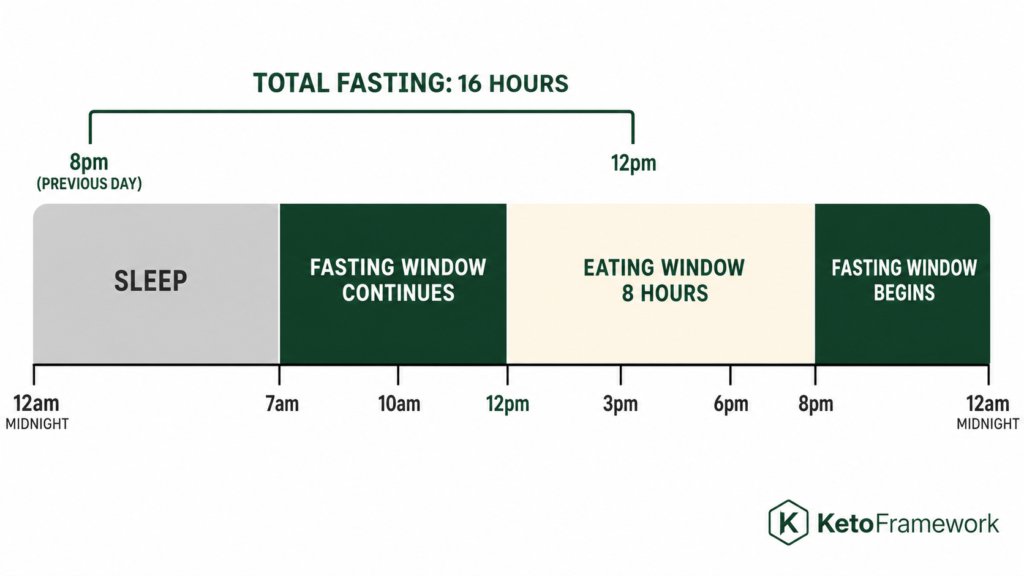
An intermittent fasting schedule is simply a daily structure that defines two things: when you stop eating and when you start eating again. Everything in between is either your fasting window or your eating window. The two windows together always add up to 24 hours.
The schedule is not a meal plan. It does not tell you what to eat. It tells you when. What you eat during the eating window matters, but the schedule itself is about timing only.
What makes an IF eating schedule different from just skipping breakfast is intention and consistency. Skipping breakfast on a random Tuesday has no meaningful metabolic effect. Skipping breakfast every day because your eating window starts at 12pm, held consistently over weeks, produces the sustained hormonal adaptation that makes intermittent fasting work. The schedule is the mechanism. Consistency is what activates it.
The most common intermittent fasting schedules and their eating windows:
| Schedule | Fasting Window | Eating Window | Eating Period Example |
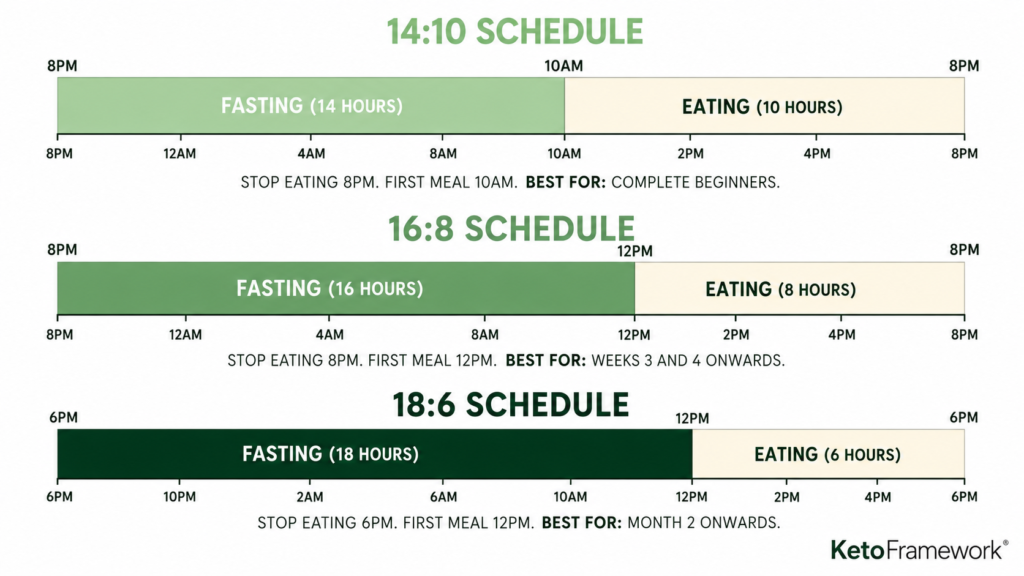
| 14:10 | 14 hours | 10 hours | 10am to 8pm |
| 16:8 | 16 hours | 8 hours | 12pm to 8pm |
| 18:6 | 18 hours | 6 hours | 12pm to 6pm |
| 20:4 | 20 hours | 4 hours | 2pm to 6pm |
| 5:2 | 2 days restricted per week | 5 normal days | Monday and Thursday restricted |
The 16:8 schedule is by far the most researched and most widely used. A meta-analysis published in PMC (Huang et al., Food Science and Nutrition, 2023)[1] analysed eight randomised controlled trials on 16:8 in overweight and obese adults and found significant body weight reduction of 1.48kg and fat mass reduction of 1.09kg across studies. The consistency of results across eight separate trials is what makes 16:8 the anchor recommendation. It is not just that it works in one study. It works reliably across multiple populations and study designs.
The Best Intermittent Fasting Schedule for Beginners
The best intermittent fasting schedule for beginners is the simplest one that establishes a consistent daily rhythm without making the first two weeks miserable. That schedule is 14:10, not 16:8.
I know 16:8 is what most articles recommend as the starting point. I disagree, and here is why. The first week of any fasting schedule involves your hunger hormone ghrelin responding to the time you used to eat. It spikes at your old breakfast time and produces real, uncomfortable hunger. At 14:10, that spike happens at around 9am or 10am and subsides within 30 to 45 minutes. At 16:8, it happens at the same time but you still have two more hours to wait. That two-hour difference is the difference between manageable and miserable in week one.
My wife started at 14:10. I started at 14:10 the second time I tried IF, after abandoning 16:8 on my first attempt. Both of us found week one entirely manageable at 14:10. Both of us were at 16:8 naturally within three weeks without forcing it.
The fasting schedule for beginners I recommend
Weeks 1 and 2: 14:10 fasting schedule. Stop eating: 8pm. First meal: 10am. Total fasting window: 14 hours. Your only job: establish the habit. Do not change what you eat yet.
Weeks 3 and 4: Move toward 16:8. Push the first meal back by one hour to 11am for three to four days. Then push to 12pm. You have moved from 14:10 to 16:8 without a single difficult day.
Month 2 onwards: 16:8 consistently. Eating window 12pm to 8pm. This is the schedule the research supports most strongly. Hold it consistently for at least four weeks before considering any further extension.
Month 3 onwards: 18:6 if it happens naturally. An 18-hour fasting window with a 6-hour eating window, typically 12pm to 6pm. My wife and I both moved here naturally after six weeks of 16:8. Never force this extension.
How to Build Your Intermittent Fasting Daily Schedule

Building an intermittent fasting daily schedule that works long term comes down to four decisions. Make these once and the schedule runs itself.
1. Fix your eating window close time first
The single most important anchor in any IF eating schedule is the time you stop eating in the evening. This is the anchor because it determines everything else. If you stop eating at 8pm, your fasting window begins at 8pm. Your first meal the next day is determined by your target fasting window: 10am for 14:10, 12pm for 16:8, 12pm for 18:6 if closing at 6pm.
Most people find it easier to fix the evening close time than the morning open time, because evenings have more predictable social and family structure. Pick a close time you can hold on most days including weekends. 8pm is the most commonly used and most practical close time for most people.
2. Set your first meal time and protect it
Once the close time is fixed, your first meal time is simply close time plus your fasting window. For 16:8 with an 8pm close: 8pm plus 16 hours equals 12pm. That is your first meal time. Set it as a daily reminder if it helps in the first two weeks. After that it becomes instinctive.
The reason I say protect it is that the most common schedule failure point is not the evening close but the morning open. A family breakfast, a work meeting with food, a social occasion: these are the moments when the eating window gets pushed earlier and the fast gets shortened. Protecting the first meal time is where the consistency is won or lost.
3. Decide how many meals fit your eating window
For a 16:8 schedule with a 12pm to 8pm eating window, two to three meals fit comfortably. My typical structure:
12pm: First meal, protein and fat forward. Eggs with avocado, or salmon with leafy greens.
3pm to 4pm: Second meal or substantial snack. Full-fat yoghurt with nuts, or a protein-led meal.
7pm: Final meal, whatever is being cooked at home that evening, prioritising protein.
For an 18:6 schedule with a 12pm to 6pm eating window, two meals works better than three. The eating window is short enough that squeezing three full meals in creates unnecessary pressure. Two proper meals with a small snack if genuinely hungry is the structure that feels most natural.
4. Align the schedule with your daily routine, not against it
The reason most IF schedules fail is not biology. It is scheduling. A 16:8 schedule that requires you to skip a family dinner is not sustainable. A schedule that conflicts with a demanding morning work routine will be broken repeatedly. The best intermittent fasting schedule is the one that sits within your existing daily rhythm with minimal friction.
If your family eats dinner at 9pm, close at 9pm and open at 1pm. The specific hours matter less than the window length and the consistency of holding it. A 16-hour window from 9pm to 1pm produces the same metabolic benefit as a 16-hour window from 8pm to 12pm. Adjust the times to your life. Do not adjust your life to arbitrary times.
IF Eating Schedule: A Full Sample Day
Here is what my own intermittent fasting daily schedule looks like in practice on a typical day. This is not a meal plan. It is a timing framework. Adapt the food to whatever works for you.
| Time | What I Do | Why |
| 7am | Wake up. Glass of water with a pinch of sea salt. | Hydration and electrolytes. The fasting window has been running since 8pm. |
| 7am to 12pm | Water, black tea, black coffee (nothing added), sparkling water. Nothing else. | All of these are metabolically neutral. The fast continues. |
| 11am to 12pm | Hunger may appear briefly. Drink water or black tea. It passes. | This is ghrelin responding to the old breakfast time. It fades within 20 to 30 minutes. |
| 12pm | First meal. Protein and fat forward. Eggs cooked in butter with avocado and leafy greens, or salmon with olive oil dressing. | Breaks the fast with a moderate insulin response. High satiety for 3 to 4 hours. |
| 3pm to 4pm | Second meal or snack. Full-fat yoghurt with nuts, or a light protein meal. | Maintains protein intake through the eating window. Prevents excessive hunger at the final meal. |
| 7pm | Final meal. Whatever is being cooked at home. Prioritise protein. | Closes the eating window on a full, satisfying meal. |
| 8pm | Eating window closes. Water and herbal tea only from here. | The fasting window begins again. 16 hours until the next eating window. |
| 8pm to midnight | Water or herbal tea if thirsty. Nothing else. | The fast runs overnight. No hunger because the final meal was satisfying and the body adapts quickly. |
Why Consistency in the Schedule Matters More Than the Specific Times
The most important thing I can tell you about building an intermittent fasting schedule is this: the specific times matter far less than holding them consistently.
The metabolic benefit of intermittent fasting comes primarily from two mechanisms. First, the sustained low-insulin state during the fasting window, which drives fat oxidation. Second, the alignment of eating with your body’s natural daily metabolic rhythm, what researchers call circadian alignment.
A systematic review and meta-analysis published in PMC (Moon et al., Nutrients, 2020)[2] found that time-restricted eating works in part by synchronising peripheral metabolic clocks with the central circadian clock, and that eating within a consistent daily window reduces circadian disruption, improving metabolic pathways for glucose and fat regulation. The finding matters because it explains why an irregular eating pattern with no consistent schedule produces different results from the same total fasting hours held at a consistent time each day. The body’s metabolic systems are time-sensitive. They respond to consistent timing, not just the total duration of the fast.
A study published in PubMed (Gabel et al., Nutrition and Healthy Aging, 2018)[3] found that adults following a consistent 16:8 schedule ate around 340 fewer calories per day without any deliberate calorie restriction, and lost 2.6 percent of body weight over 12 weeks. The calorie reduction happened automatically because a consistent eating window regulates appetite. When the schedule is consistent, the appetite adapts to it. The hunger that filled the mornings in week one is largely gone by week three, replaced by stable energy and a natural reduction in the drive to eat.
What breaks most IF schedules is not hunger. It is inconsistency. A week of perfect 16:8 followed by a weekend of no schedule produces no lasting hormonal adaptation. A month of 14:10 held consistently every day, including weekends, produces the full adaptation that makes fasting easy, appetite reliable, and results measurable.
Keep the times. Especially on weekends.
Intermittent Fasting Schedule for Different Lifestyles
Not everyone’s daily routine looks the same. Here is how to adapt the IF schedule to three common situations.
Early riser with an early finish
If you wake at 5am or 6am and your day ends early, shift the entire window earlier. Stop eating at 6pm. First meal at 10am for 16:8. The 16-hour window runs from 6pm to 10am, mostly overnight. This is actually closer to what researchers call early time-restricted eating, which some evidence suggests may have slightly stronger effects on insulin sensitivity because it is better aligned with the body’s natural peak insulin sensitivity in the morning hours.
Shift worker or irregular schedule
Shift work makes a fixed daily schedule genuinely difficult. The 5:2 approach may work better than daily time restriction in this case. Choose two consistent days per week for restricted eating (500 to 600 calories across the day) and eat normally on the other five. The metabolic benefit is lower than consistent daily TRE but the adherence is more realistic when your working hours change week to week.
Family with evening meals together
If family dinner is a fixed and important part of your day, close the eating window after it, not before. If family dinner is at 7pm or 8pm, close at 8pm or 9pm and push the first meal to 12pm or 1pm accordingly. A 16:8 window from 9pm to 1pm is just as metabolically valid as 8pm to 12pm. The family meal is worth protecting. The IF schedule can flex around it.
Frequently Asked Questions About Intermittent Fasting Schedules
What is the best intermittent fasting schedule for beginners?
The best intermittent fasting schedule for beginners is 14:10: stop eating at 8pm, first meal at 10am. This is the schedule that establishes the fasting habit with the least disruption to your existing routine. After two weeks of consistent 14:10, most people find the transition to 16:8 straightforward because the adaptation has already happened. Starting directly at 16:8 or 18:6 is possible but makes the first week harder than it needs to be.
What time should I start and stop eating on a 16:8 schedule?
The most commonly used 16:8 schedule is 12pm to 8pm. Stop eating at 8pm, first meal at 12pm. This works well for most people because the fasting window runs overnight and through the morning when activity and black coffee or tea keep hunger low, and the eating window covers lunch, a mid-afternoon meal, and dinner. If your lifestyle requires a different window, any consistent 8-hour period works. The specific hours are less important than holding them consistently.
How do I schedule intermittent fasting around exercise?
If you exercise in the morning during the fasting window, train fasted and break your fast within an hour of finishing your session with a protein-forward meal. Black coffee before training does not break the fast and can improve performance. If you exercise in the afternoon during the eating window, ensure you have eaten at least one meal before training and prioritise protein in the meal immediately after. Work with your existing training schedule rather than restructuring everything at once.
Can I shift my intermittent fasting schedule on weekends?
A small shift of one to two hours on weekends is unlikely to significantly disrupt adaptation. Shifting by four or more hours consistently on weekends is essentially resetting part of the hormonal adaptation you built during the week. The research on circadian alignment suggests that consistency across all days of the week produces better metabolic outcomes than a schedule held perfectly on weekdays and abandoned on weekends. Where possible, keep the weekend schedule within two hours of the weekday schedule.
How long does it take for an IF schedule to feel natural?
Most people find the fasting schedule feels actively difficult for the first five to seven days, noticeably easier by days eight to ten, and largely effortless by the end of week two to three. The morning hunger that dominates the first week is primarily ghrelin adapting to a new eating pattern. Once ghrelin has recalibrated to the new schedule, the mornings become genuinely comfortable. The question I was asked most by my wife during her first two weeks was whether it would always be this hard. The honest answer is no. By week three she was not thinking about the schedule anymore. That is what adaptation looks like.
Should I eat the same times every day on an IF schedule?
Yes, as much as your lifestyle allows. The circadian alignment research is clear that consistent daily timing produces better metabolic outcomes than variable timing. Your body’s metabolic systems respond to regular cues, including meal timing. Eating at consistent times within the eating window strengthens those cues. Aim for consistency in both the window and the meals within it.
Intermittent Fasting Schedule: The One Rule That Makes It Work
The one rule worth remembering from this entire article is simple: pick a schedule you can hold consistently, every day, including weekends, for at least four weeks before judging whether it is working.
That is it. Not the optimal hours. Not the most advanced window. Not the perfect meal timing within the eating window. Consistency in the schedule is the mechanism. Everything else is detail.
My wife and I both built our schedule around our family life first and the research second. We stopped eating after the evening meal. We pushed the first meal to a time that felt comfortable rather than ambitious. We held those times consistently. The results came from the consistency, not from precision.
The complete intermittent fasting framework with meal plans, method comparisons, and everything you need beyond the schedule is in the intermittent fasting diet plan. For a deeper understanding of what is happening biologically during your fasting window, the guide on what is intermittent fasting covers the full mechanism. And for the question of exactly how long to fast, the fasting window guide covers every window from 14 hours to 20 hours and what each one produces.
References
All sources cited in this article are peer-reviewed studies sourced from PubMed or PMC. This article is for informational purposes and does not constitute medical advice. If you have an existing health condition, are pregnant or breastfeeding, or take medication requiring food intake, consult your doctor before starting intermittent fasting.
1. Huang T, Zheng Y, Li J, et al. Is time-restricted eating (8/16) beneficial for body weight and metabolism of obese and overweight adults? A systematic review and meta-analysis of randomized controlled trials. PMC, Food Science and Nutrition, 2023. https://www.ncbi.nlm.nih.gov/pmc/articles/PMC10002957/
2. Moon S, Kang J, Kim SH, et al. Beneficial effects of time-restricted eating on metabolic diseases: a systematic review and meta-analysis. PMC, Nutrients, 2020. https://www.ncbi.nlm.nih.gov/pmc/articles/PMC7284632/
3. Gabel K, Hoddy KK, Haggerty N, et al. Effects of 8-hour time restricted feeding on body weight and metabolic disease risk factors in obese adults: a pilot study. PubMed, Nutrition and Healthy Aging, 2018. https://pubmed.ncbi.nlm.nih.gov/29951594/