
14:10 intermittent fasting is where my wife and I both started. Not 16:8. Not 18:6. 14:10.
Every guide I had read before starting IF recommended jumping straight to 16:8. The first time I tried that I lasted three days before the morning hunger and headaches convinced me IF was not for me. The second time I started at 14:10. My wife started at 14:10 when she joined me a few weeks later. Both of us found the first week entirely manageable. Both of us were at 16:8 within three weeks without forcing it.
The reason 14:10 is the right starting point for every IF beginner is not that it is easier in some superficial sense. It is that the hormonal adaptation that makes 16:8 sustainable happens most effectively when you start at 14:10 and let it build. Starting at 16:8 before that adaptation is even begun makes week one harder than it needs to be, produces no better long-term results, and is responsible for most of the early IF failures I hear about.
This article is the complete guide to 14:10 intermittent fasting: what it is, how to do it, what happens each day of the first week, how to progress from here, and what the research shows it produces.
For the complete IF framework covering every method and schedule, the intermittent fasting diet plan is the full guide. If you are deciding whether IF is right for you before choosing a starting protocol, the intermittent fasting for beginners guide covers everything you need to know first.
What Is 14:10 Intermittent Fasting?
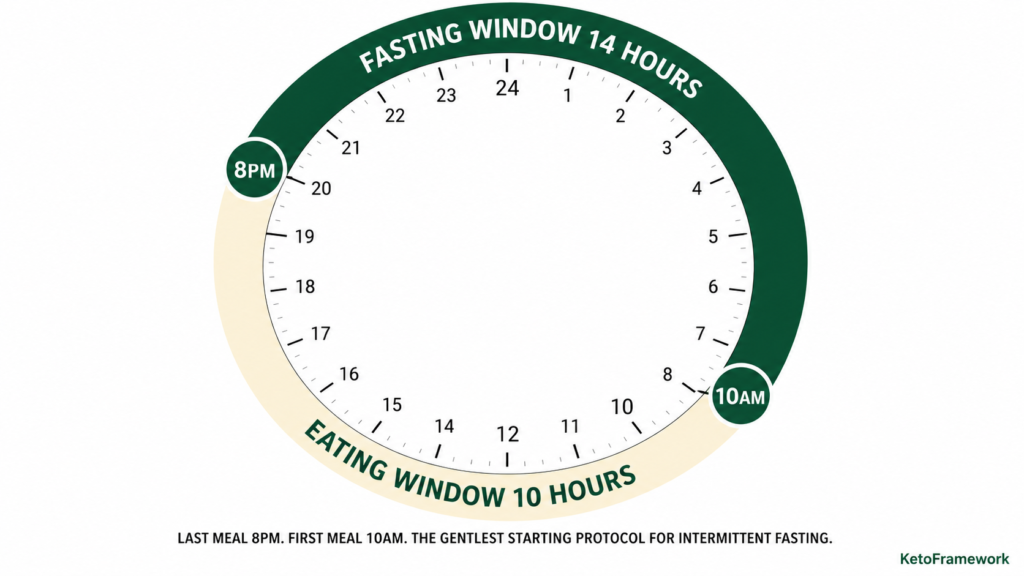
14:10 intermittent fasting is a time-restricted eating protocol in which you fast for 14 consecutive hours and eat all of your meals within a 10-hour window. The numbers refer to the ratio: 14 hours fasting, 10 hours eating.
The most common 14:10 fasting schedule is:
Last meal: 8pm
First meal: 10am the following day
Eating window: 10am to 8pm
Fasting window: 8pm to 10am (14 hours)
This is two hours of additional fasting on each side of your overnight sleep compared to a standard eating pattern. If you currently stop eating at 8pm and eat breakfast at 8am, you are already doing 12 hours of overnight fasting without trying. 14:10 simply extends that existing overnight fast by two hours, by having your first meal at 10am rather than 8am.
That is it. Stop eating at 8pm. First meal at 10am. Everything else stays the same in week one. No change to what you eat. No calorie counting. No complicated meal planning. Two hours later for the first meal.
Why 14:10 Is the Right Starting Protocol for Every Beginner
The most common mistake in intermittent fasting is starting at 16:8. Not because 16:8 is wrong. It is the most researched and most effective long-term IF protocol. But starting at 16:8 before any fasting adaptation has happened is why most people struggle in week one and many abandon IF before the adaptation completes.
The ghrelin problem
Your hunger hormone ghrelin is trained to expect food at the times you usually eat. It follows a circadian rhythm based on your habitual eating pattern. When you suddenly stop eating at 7am or 8am as part of a 16:8 schedule, ghrelin spikes hard at your old breakfast time. That spike produces real, uncomfortable hunger that peaks around hour two or three of the extended fast and is much more manageable at 14:10 than at 16:8.
At 14:10, the first meal time is 10am. Most people who used to eat breakfast at 7am or 8am find that two extra hours of hunger in the morning is genuinely manageable from day one. At 16:8, the first meal is at 12pm. Four to five extra hours of hunger on day one with no adaptation built yet is what produces the miserable first week that convinces people IF does not work for them.
The adaptation itself takes five to seven days for most people. At the end of that period, ghrelin has recalibrated to the new eating pattern and morning hunger largely disappears. My wife noticed it clearly by day five. I noticed it by day seven. But that adaptation window is significantly more comfortable at 14:10 than at 16:8.
What 14:10 actually produces
The research confirms that 14:10 is not just a comfortable on-ramp. It produces real metabolic results. A randomised controlled trial published in PMC (Peeke et al., Nutrition and Diabetes, 2021)[1] tested a 14-hour TRE protocol (14:10) in adults with obesity over 8 weeks. Participants in the 14:10 group lost a statistically significant 8.5 percent of body weight and showed a significant reduction in fasting blood glucose compared to a 12-hour fasting control group. The 14:10 group produced meaningfully better results than the 12-hour comparator on both weight and glucose markers.
A meta-analysis published in PMC (Moon et al., Nutrients, 2020)[2] reviewed 19 studies on time-restricted eating and found that participants showed significantly reduced body weight, reduced fat mass, preserved fat-free mass, improved blood pressure, and improved fasting glucose compared to controls. The benefits of consistent TRE, even at the shorter end of the fasting window range, are well established across the literature.
14:10 is not a compromise. It is a foundation. The metabolic adaptation it builds is exactly what makes 16:8 feel natural within two to three weeks, rather than like a constant struggle.
The 14:10 Fasting Schedule: What a Typical Day Looks Like
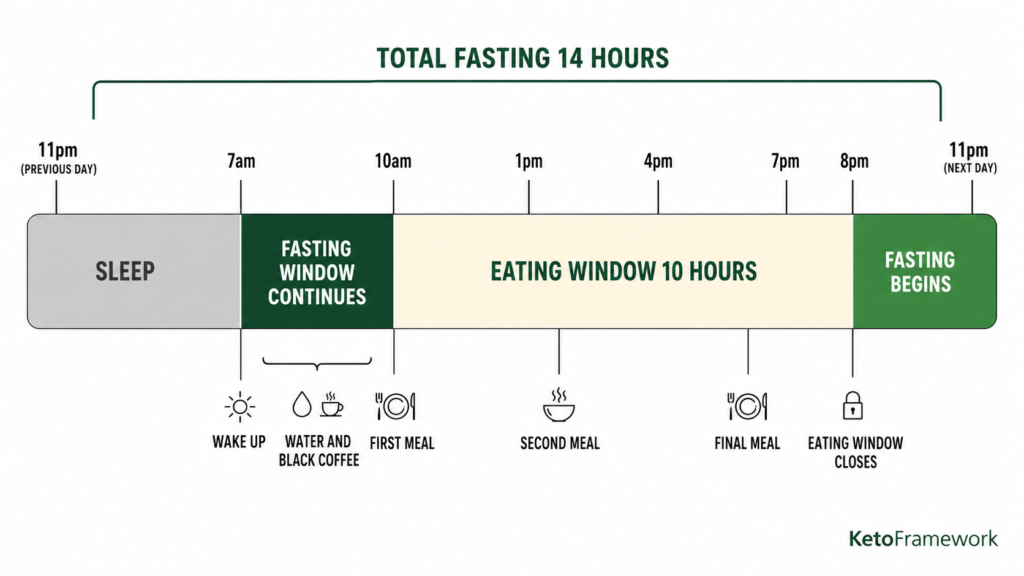
Here is what a typical day on 14:10 looks like in practice. This is the schedule I followed in my first two weeks of IF, and the schedule my wife followed when she started.
7am: Wake up. Large glass of water with a pinch of sea salt. The fasting window has been running since 8pm.
7am to 10am: Water, black tea, plain black coffee (nothing added), sparkling water, water with lemon. The fasting window continues. Three hours of work or morning routine before the eating window opens.
10am: Eating window opens. First meal. Protein and fat forward: eggs with avocado and leafy greens, or full-fat yoghurt with nuts. Not cereal. Not toast.
1pm to 2pm: Second meal. Salmon with a salad, or chicken with roasted vegetables. Substantial enough to carry through to dinner without snacking.
7pm: Final meal. Whatever is being cooked at home. Protein forward. Vegetables included.
8pm: Eating window closes. Water and herbal tea only from here. The fasting window begins again.
The eating window structure is flexible within the 10-hour window. What is not flexible is the close time. 8pm is the anchor. Hold it every day. For the full guide to building a daily schedule that fits your life, the intermittent fasting schedule covers every variation.
The First Week of 14:10: What to Expect Day by Day
Your first week of 14:10 intermittent fasting will follow a consistent pattern. Understanding it in advance means you will not misread normal adaptation symptoms as signs that something is wrong.
| Day | What Typically Happens | What to Do |
| Day 1 | Manageable. The change is small. Mild hunger in the late morning. Energy largely normal. | Drink a large glass of water with a pinch of sea salt first thing. Black tea or coffee if you drink it. |
| Day 2 | Mild hunger at your usual breakfast time. Ghrelin responding to its trained schedule. May dip slightly in energy. | Same as day one. The hunger rises and passes within 30 to 45 minutes without food. Drink water. |
| Day 3 | Often the hardest day. Hunger stronger in the morning. Some people experience mild headaches or low energy. | Primarily electrolyte depletion. Add sea salt to water twice today. Magnesium glycinate before bed. |
| Day 4 | For most people the hunger begins to ease. Energy starts to return. | Continue the same schedule. The improvement from day three to day four is often noticeable. |
| Day 5 | Hunger at the fasting window noticeably reduced. Some people report stable energy for the first time. | Notice how you feel at the time you would normally have eaten breakfast. The adaptation is happening. |
| Day 6 and 7 | Pattern becoming familiar. Morning hunger largely resolved. First week complete. | You have completed week one of 14:10. Continue for another week before extending the window. |
The Four Things That Make Week One Work

1. Electrolytes from day one
The most common reason people feel terrible in the first week of 14:10 is electrolyte depletion, not hunger. During the fasting window, insulin stays low. Low insulin signals the kidneys to excrete more sodium, and sodium loss pulls magnesium and potassium with it. The headaches and fatigue of days two and three are almost entirely this mechanism. A quarter teaspoon of sea salt in a large glass of water first thing in the morning fixes most of it. The full electrolyte protocol is in the electrolytes on keto guide, which applies equally to IF.
2. Know what you can have during the fasting window
Water, plain sparkling water, black coffee with nothing added, plain herbal tea, plain green or black tea, water with a squeeze of lemon, and plain electrolyte powder with no sugar or sweetener. That is the complete list. Milk, cream, sugar, sweeteners, protein shakes, and fruit juice all raise insulin and break the fast. The full breakdown is in the what can you eat while intermittent fasting guide.
3. Break the fast correctly at 10am
After 14 hours of fasting, insulin is at its lowest point of the day. The first meal triggers the largest insulin response of the day. Break the fast with protein and fat first: eggs with avocado and leafy greens, salmon with olive oil, or full-fat Greek yoghurt with mixed nuts. Starting with cereal, toast, or fruit juice produces a large insulin spike that partially offsets the metabolic work of the fasting window. The how to break a fast guide covers every scenario in detail.
4. Do not quit on day three
Day three is the most common quit point of any IF protocol, and 14:10 is no exception. The novelty has worn off. The adaptation is not yet complete. Hunger is at its peak. Electrolytes are depleted if you have not been managing them. Everything feels harder than it should.
Day three is not a sign that IF does not work for you. It is the peak of the adaptation curve. Day four is almost always noticeably easier. Day seven is genuinely manageable. Day ten is often the first morning you wake up and realise you are not hungry before 10am and cannot quite remember when that started happening.
14:10 Fasting Results: What to Expect and When
Here is the realistic timeline of what 14:10 produces, based on the research and on what I observed personally.
Week one: adaptation, not fat loss
The first week of 14:10 is about hormonal adaptation, not fat loss. You will likely see a reduction on the scale of one to two kilograms, but most of that is water from glycogen depletion and reduced water retention from lower insulin. This is real and visible but it is not fat loss. Do not judge the approach on week one numbers.
The meaningful first-week result is the change in morning hunger. If by day seven you are noticeably less hungry before 10am than you were on day one, the hormonal recalibration is working on schedule.
Weeks two and three: the hormonal shift
By the end of week two, the morning hunger that dominated week one should be largely absent for most people. This is ghrelin adapting its rhythm to the new eating pattern. Energy begins to stabilise. The fasting window starts to feel like routine rather than effort.
This is also where the first genuine fat loss becomes measurable. Not dramatic at this stage, but real and consistent. Expect roughly 0.5 to 1 kilogram of genuine fat loss in weeks two and three combined if the eating window is clean.
Weeks four to eight: consistent fat loss
By week four, 14:10 should feel entirely natural. At this point you can either hold 14:10 if it is producing the results you want, or transition to 16:8 by pushing the first meal back to 12pm. The research confirms that consistent TRE produces meaningful results over 8-week periods. A meta-analysis published in PMC (Moon et al., Nutrients, 2020)[2] found that TRE participants showed significant reductions in body weight, fat mass, and cardiometabolic risk markers over study periods of multiple weeks. The same adaptation that makes 14:10 easy by week four is what makes the transition to 16:8 feel natural rather than difficult.
How to Progress from 14:10 to 16:8
When to move from 14:10 to 16:8
The right time to move from 14:10 to 16:8 is when 14:10 feels genuinely easy. Not when you think you should be ready. Not because two weeks have passed. When the morning hunger before 10am has largely resolved and the fasting window runs without active management.
That transition typically happens naturally for most people at two to three weeks. My wife moved from 14:10 to 16:8 at the start of week three. I moved at the end of week two. Both moves felt natural rather than ambitious because we waited for the adaptation to signal readiness rather than pushing before it was complete.
How to make the transition
Do not jump from 10am to 12pm in one day. Push the first meal back by one hour to 11am and hold there for three to four days. Then push to 12pm. You are now at 16:8 without a single dramatically difficult day. Each small extension triggers a new but manageable adaptation cycle rather than a full reset of the hunger adjustment.
This one-hour-at-a-time progression is the most reliable way to move between IF windows. For everything that comes after 16:8, including 18:6 and beyond, the 16:8 intermittent fasting guide covers the next stage of the progression in full.
The full progression from 14:10 to 18:6
| Phase | Schedule | Duration | Goal |
| Phase 1 | 14:10 | Weeks 1 and 2 | Establish the habit. Stop eating at 8pm. First meal at 10am. Nothing else changes. |
| Phase 2 | 15:9 or 16:8 | Weeks 3 and 4 | Push first meal to 11am then 12pm. One hour at a time. |
| Phase 3 | 16:8 consistent | Month 2 | Hold 12pm to 8pm eating window. This is the sweet spot for most people. |
| Phase 4 | 18:6 optional | Month 3 onwards | Extend only if it happens naturally. Never force it. |
The progression is not a requirement. Many people stay at 16:8 long term and produce the full range of IF results the research shows. 18:6 is only worth moving to if the transition happens naturally after extended consistent 16:8.
14:10 Fasting Schedule: The Allowed and Not Allowed Lists
These lists are the same at 14:10 as at any other fasting window. The insulin rule that governs what breaks a fast does not change based on fasting duration.
ALLOWED during the fasting window
| Item | Notes |
| Still water | As much as you want. Active hydration is essential during the fasting window. |
| Sparkling water (plain) | Same zero-calorie profile as still water. Not flavoured with sweeteners. |
| Black coffee (nothing added) | Does not raise insulin. Mild appetite suppressant. Must stay completely plain. |
| Plain herbal tea | No milk, no sweetener of any kind. |
| Plain green or black tea | No milk, no sweetener of any kind. |
| Water with a squeeze of lemon | Negligible calorie content. No meaningful insulin impact. |
| Plain electrolyte powder (no sugar) | Check the label. Must contain no sugar, sweeteners, or calories. |
BREAKS YOUR FAST
| Item | Notes |
| Milk or cream | Contains lactose and protein. Raises insulin. Even a small splash breaks the fast. |
| Sugar or sweeteners | Raises blood glucose. Breaks the fast immediately. |
| Fruit juice | High in fructose. Large and rapid insulin response. |
| Protein shakes | Protein raises insulin. Belongs in the eating window only. |
| Any food | Any calories break the fasting window. |
Who 14:10 Fasting Is Right For
14:10 intermittent fasting is appropriate for: anyone who is completely new to intermittent fasting, anyone who tried 16:8 and found week one miserable and gave up, anyone whose daily schedule requires a morning meal before 12pm, and anyone who wants to build the fasting habit before committing to a longer window.
14:10 is also a reasonable long-term protocol for anyone who finds that the 10-hour eating window produces good results and sustainable adherence. There is no obligation to progress to 16:8. The best fasting window is the one that fits your life and that you can hold consistently. A 14:10 schedule held every day for a year produces better results than a 16:8 schedule held three days a week.
14:10 carries the same contraindications as all IF protocols. Not recommended without medical guidance for: pregnant or breastfeeding women, people with a history of eating disorders, people on medications that require food intake, people with type 1 diabetes or those managing blood glucose with insulin or glucose-lowering medications, children and adolescents, and people with a history of hypoglycaemia. If you have any existing health condition, consult your doctor before starting.
Frequently Asked Questions About 14:10 Intermittent Fasting
Is 14:10 fasting effective for weight loss?
Yes. The research published in PMC (Peeke et al., 2021) specifically on 14:10 found statistically significant weight loss of 8.5 percent over 8 weeks and meaningful reduction in fasting blood glucose. 14:10 is not as aggressive as 16:8 or 18:6, but it produces real and measurable results, particularly when the eating window is clean and protein-forward. For most beginners, 14:10 is also the protocol they can actually hold consistently, which matters more than protocol strength in the first month.
How long should I stay at 14:10 before moving to 16:8?
Two to three weeks is the typical transition point. The signal to move is not time but adaptation: is the morning hunger before 10am largely absent? Does the fasting window run without active effort? If yes, you are ready. If no, stay at 14:10 for another week. The adaptation is what makes 16:8 accessible. Skipping it by moving too early just makes week one of 16:8 harder than it needs to be.
Can I eat anything I want during the 14:10 eating window?
Technically yes, but practically no. 14:10 with a poor eating window produces poor results. The fasting window creates the hormonal conditions for fat loss. The eating window determines how effectively you use those conditions. Breaking the fast with refined carbohydrates and processed food partially offsets the metabolic work of the fasting period. Protein and fat forward at the first meal, vegetables at every meal, minimal refined carbohydrates throughout the window. These are not rules unique to 14:10. They are the eating window principles that apply across every IF protocol.
Will 14:10 feel harder than 16:8 once I am adapted?
No. Once the hormonal adaptation to 14:10 is complete, the fasting window runs without effort. The difference between 14:10 and 16:8 in terms of daily experience is minimal once both adaptations are done. The difference is most acute before adaptation: 14:10 is much more manageable in week one for someone who has never fasted before. After adaptation, both schedules feel like the same kind of background rhythm.
What if I am not hungry at all by 10am during 14:10?
This is a positive sign. It means ghrelin has recalibrated faster than expected and the adaptation is ahead of schedule. You have two options: eat anyway at 10am to stay at 14:10 while the adaptation solidifies, or let the first meal drift to 11am or 12pm if you genuinely have no appetite. Either is fine. If you find yourself naturally waiting until 12pm consistently, you have moved to 16:8 without planning to. That is the most reliable and comfortable way to make the progression.
14:10 Intermittent Fasting: The Simple Version
Stop eating at 8pm. First meal at 10am. Hold that for two weeks. That is the complete 14:10 intermittent fasting protocol.
Everything else in this article, the day-by-day first-week guide, the electrolyte fix, the allowed and not allowed lists, the progression to 16:8, is support material for those two anchor points. The schedule itself requires two decisions and one habit. That simplicity is why it works as a starting point when more aggressive approaches fail.
My wife and I both went through exactly this progression. 14:10 for two weeks. 16:8 by the end of week three. 18:6 about six weeks after that, without planning it. The body led. We followed. That is how IF is supposed to work.
The complete IF framework with every method and the meal plan that runs alongside it is in the intermittent fasting diet plan. For the next step when 14:10 becomes easy, the 16:8 intermittent fasting guide covers exactly how to progress. And for understanding how long each fasting window takes to produce results, the how long should you fast guide covers every window from 14 hours to 20 hours.
References
1. Peeke PM, Greenway FL, Billes SK, Zhang D, Fujioka K. Effect of time restricted eating on body weight and fasting glucose in participants with obesity: results of a randomized, controlled, virtual clinical trial. PMC, Nutrition and Diabetes, 2021. https://www.ncbi.nlm.nih.gov/pmc/articles/PMC7809455/
2. Moon S, Kang J, Kim SH, et al. Beneficial effects of time-restricted eating on metabolic diseases: a systematic review and meta-analysis. PMC, Nutrients, 2020. https://www.ncbi.nlm.nih.gov/pmc/articles/PMC7284632/
3. Huang T, Zheng Y, Li J, et al. Is time-restricted eating (8/16) beneficial for body weight and metabolism of obese and overweight adults? A systematic review and meta-analysis of randomized controlled trials. PMC, Food Science and Nutrition, 2023. https://www.ncbi.nlm.nih.gov/pmc/articles/PMC10002957/