
My wife and I did not plan to move to 18:6 intermittent fasting. We planned to stay at 16:8.
After about six weeks of consistent 16:8, the eating window started closing earlier on its own. Neither of us was hungry enough to eat until 6pm or 7pm most evenings. We were not deliberately restricting. The appetite regulation that 16:8 had been building just made eating later feel unnecessary. We realised we had been running what is essentially an 18:6 window without intending to.
That natural progression is the most important thing I can tell you about 18:6 intermittent fasting. It is not a protocol you force. It is what consistent 16:8 often becomes when the hormonal adaptation matures.
This article explains what 18:6 intermittent fasting is, how it differs from 16:8, what the research shows about results, who it is right for, and how to move to it correctly when the time comes.
For the full intermittent fasting framework, the intermittent fasting diet plan covers every method and schedule. If you are not yet on a consistent fasting schedule, start with 16:8 intermittent fasting first. 18:6 is a progression, not a starting point.
What Is 18:6 Intermittent Fasting?
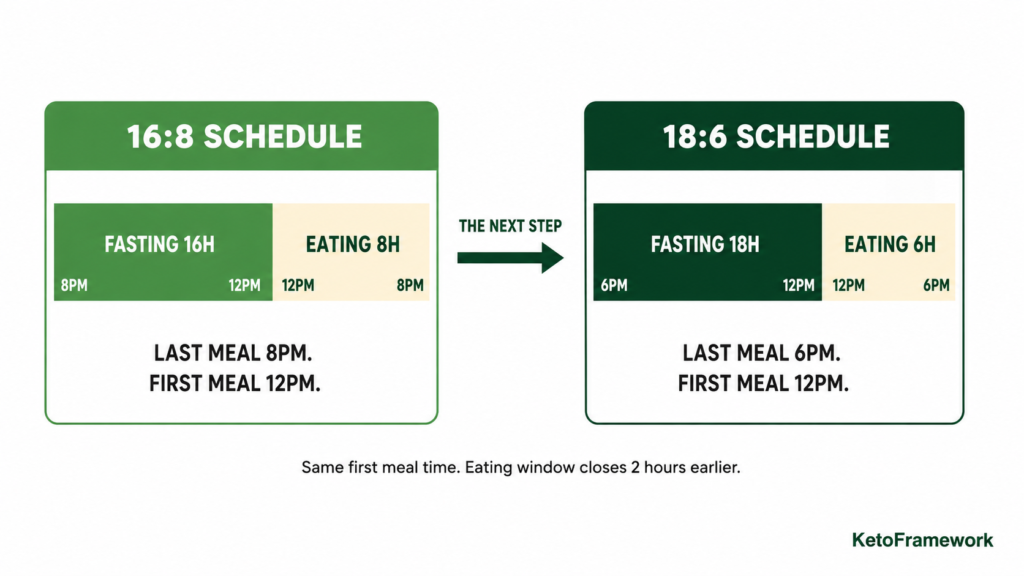
18:6 intermittent fasting is a time-restricted eating protocol in which you fast for 18 consecutive hours and eat all of your meals within a 6-hour window. The numbers refer to the ratio: 18 hours fasting, 6 hours eating.
The most common 18:6 fasting schedule is:
Last meal: 6pm
First meal: 12pm the following day
Eating window: 12pm to 6pm
Fasting window: 6pm to 12pm (18 hours)
The difference from 16:8 is two hours. The eating window closes two hours earlier in the evening. The fasting window extends by two hours. That sounds like a small change. In practice, those two hours extend the fat-burning window into territory where the metabolic effects are meaningfully stronger and where many people first begin producing measurable ketones even on a non-ketogenic diet.
18:6 vs 16:8: The Key Differences
The comparison between 18:6 and 16:8 is simple on paper but more significant in practice than the two-hour difference suggests.
The fasting window difference
At 16 hours, the body has been in active fat-burning mode for several hours before the eating window opens. Insulin has been at baseline since roughly hours 4 to 6. Fat oxidation is running meaningfully from around hours 10 to 12. At 16 hours, you are in a well-established fat-burning state.
At 18 hours, two things change. First, the fat-burning period extends by a further two hours, which is a meaningful addition to the daily low-insulin window. Second, some people begin producing measurable ketone bodies in this extended window even without a ketogenic diet, because the liver has had longer to draw down glycogen and shift toward fat as its primary fuel.
The difference is not dramatic from a calorie-deficit perspective. It is meaningful from a metabolic adaptation perspective. The body’s hormonal environment is different at hour 18 than at hour 16, and that difference compounds over weeks.
The eating window difference
8 hours versus 6 hours in the eating window sounds like a minor practical adjustment. In reality it changes the meal structure significantly.
On 16:8 with a 12pm to 8pm eating window, two to three full meals fit comfortably. Lunch at 12pm, a mid-afternoon snack or second meal at 3pm to 4pm, and dinner at 7pm. The window is long enough for a relaxed eating pattern that includes a proper evening meal at a typical family dinner time.
On 18:6 with a 12pm to 6pm eating window, two meals works better than three. Lunch at 12pm and an early dinner at 5pm to 5:30pm. For most people this means either eating dinner earlier than their family, which requires planning, or adjusting the whole family eating schedule earlier, which is what my wife and I did. We now eat together at 5pm to 5:30pm most evenings. The children eat at the same time. The schedule works because it became the household routine rather than an exception to it.
The appetite suppression difference
For people adapted to 16:8, the move to 18:6 is often accompanied by a further meaningful reduction in appetite across the day. The additional two hours of low-insulin fasting extends the appetite regulation benefit. Most people who have been on consistent 18:6 for four to six weeks report that two proper meals within the six-hour window is entirely satisfying and that the third meal they used to eat on 16:8 is simply not missed.
This was exactly my wife’s experience. She moved from 16:8 to 18:6 without deliberately deciding to reduce how much she ate. The eating window shortened and the appetite adapted to match it.
18:6 Fasting Results: What the Research Shows
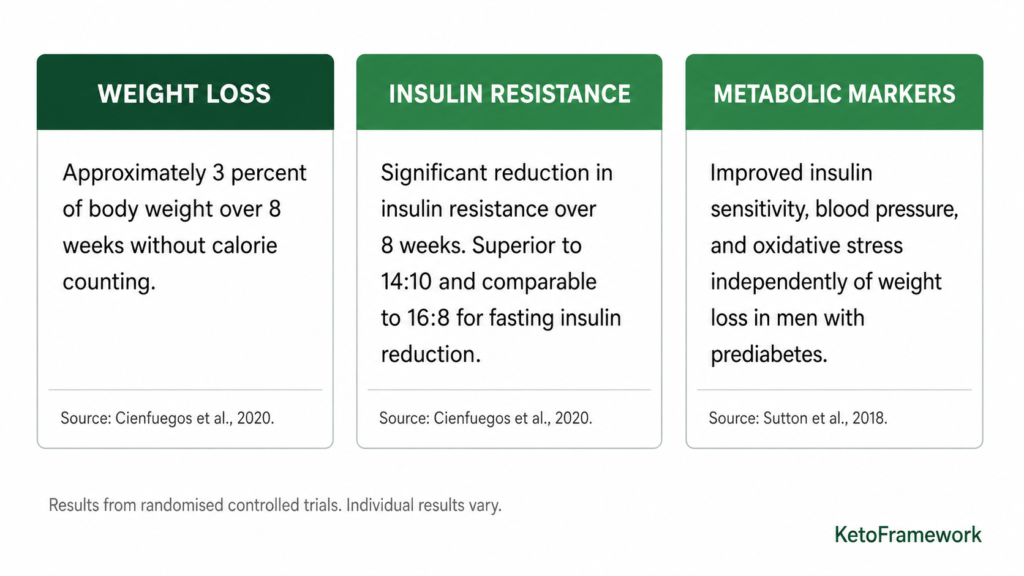
The research on the 6-hour eating window that defines 18:6 is meaningful and consistent. Here is what three verified studies actually found.
Weight loss and insulin resistance
A randomised controlled trial published in PMC (Cienfuegos et al., Cell Metabolism, 2020)[1] compared 4-hour and 6-hour eating windows in adults with obesity over 8 weeks. The 6-hour group (equivalent to an 18:6 schedule) lost approximately 3 percent of body weight without any deliberate calorie counting, reduced energy intake by approximately 550 calories per day naturally, and showed significant reductions in insulin resistance compared to controls. These results are from a properly controlled trial, not observational data, which makes them particularly reliable as a benchmark for what 18:6 can produce.
Metabolic improvement independent of weight loss
A controlled crossover trial published in PubMed (Sutton et al., Cell Metabolism, 2018)[2] used a 6-hour eating window in men with prediabetes over 5 weeks. Participants improved insulin sensitivity, blood pressure, and oxidative stress measurably, and these improvements occurred without any weight loss. The finding is significant for 18:6 specifically because it shows the metabolic benefit of the extended fasting window operates through a mechanism beyond calorie reduction. You do not need to lose weight to improve insulin sensitivity at 18:6. The extended low-insulin period produces the benefit regardless.
18:6 versus shorter fasting windows
A network meta-analysis published in PMC (Xie et al., Nutrients, 2024)[3] reviewed 27 randomised controlled trials comparing different time-restricted eating windows. The analysis found that the 18:6 window (6-hour eating window) was significantly better than the 14:10 window and comparable to 16:8 for reducing fasting insulin. For losing body fat and overall weight, a 6 to 8 hour eating window was identified as most appropriate. This is the strongest currently available evidence for how 18:6 compares to other fasting windows, and it supports using 18:6 as the natural extension of 16:8 for people looking to strengthen their results.
How to Do 18:6 Fasting: The Schedule and Transition

The 18:6 daily schedule
Here is what a typical day on 18:6 looks like in practice. This is the schedule my wife and I both follow.
7am: Wake up. Large glass of water with a pinch of sea salt. The fasting window has been running since 6pm.
7am to 12pm: Water, black tea, plain black coffee (nothing added), sparkling water, water with lemon. The fasting window continues. The morning is work, not a fight with hunger. By this stage of adaptation, morning hunger is minimal.
12pm: Eating window opens. First meal. Protein and fat forward: eggs with avocado and leafy greens, or salmon with olive oil dressing.
4pm to 5pm: Second and final meal. This is the equivalent of the evening meal. Protein is the priority. Whatever is being cooked at home that day. Lamb, chicken, fish with roasted vegetables. Enough to satisfy properly through to the next eating window at 12pm.
6pm: Eating window closes. Water and herbal tea only from here. The fasting window begins again. 18 hours until the next eating window opens.
How to transition from 16:8 to 18:6
The single most important rule about moving from 16:8 to 18:6 is this: do not force it. The transition should happen when 16:8 feels genuinely easy, not when you decide 18:6 sounds more powerful.
The right way to move from 16:8 to 18:6 is to close the eating window earlier in 30-minute increments. If your eating window currently closes at 8pm, move it to 7:30pm for a week. Then to 7pm. Then to 6:30pm. Then to 6pm. Each step is so small that the adjustment is barely noticeable. Over four to six weeks you have shifted from an 8pm close to a 6pm close without a single difficult day.
This is the reverse of how you extended from 14:10 to 16:8 by pushing the morning open time later. Here you are pulling the evening close time earlier. The biological principle is the same: gradual shifts allow hunger hormones to adapt without producing a difficult adaptation peak.
What you can have during the fasting window
Exactly the same as 16:8. Water, plain sparkling water, black coffee with nothing added, plain herbal tea, plain green or black tea, water with a squeeze of lemon, plain electrolyte powder with no sugar or sweetener. Nothing else. Milk, cream, sugar, sweeteners, protein shakes, and fruit juice all raise insulin and break the fast regardless of how long the fasting window is. For the full breakdown, the what can you eat while intermittent fasting guide covers every option.
Breaking the 18:6 fast at 12pm
The same principles apply at 18:6 as at 16:8. Break the fast with protein and fat first. After 18 hours of fasting, insulin is at its lowest point and the first meal triggers the largest insulin response of the day. A protein and fat forward first meal produces a moderate, measured response that sustains satiety through to the second meal four to five hours later. Eggs, avocado, leafy greens with olive oil. Salmon with a large salad. Full-fat Greek yoghurt with mixed nuts if a lighter option is preferred. The how to break a fast guide covers every scenario in detail.
The 18:6 Fasting Meal Plan: Two Meals Per Day
On a 6-hour eating window, the meal structure naturally simplifies to two proper meals rather than three. This is the structure my wife and I both use. Two meals within the window. Both substantial enough to carry through to the next meal or to the next eating window. No snacking outside the window.
The two-meal 18:6 structure
Meal 1 at 12pm (first meal, breaking the fast): protein and fat forward. 30 to 40 grams of protein. Eggs with avocado and leafy greens, or salmon with olive oil dressing. This meal needs to sustain you for four to five hours until the second meal.
Meal 2 at 4pm to 5pm (the main meal, closing the eating window): the equivalent of dinner. Full protein portion at 30 to 40 grams. Whatever is being cooked at home. Grilled lamb or chicken with roasted vegetables. Baked fish with broccoli and butter. Chicken curry with cauliflower rice. This meal closes the eating window and carries you through 18 hours of fasting until the next day.
6pm: eating window closes. No food from here.
Foods that work best in the 18:6 eating window
The food principles are identical to those at 16:8. Protein at every meal, minimum 25 to 35 grams. Healthy fat at every meal. Non-starchy vegetables as the base. Whole food carbohydrates as a secondary component of the second meal if needed. Refined carbohydrates minimised, especially at the first meal.
The difference at 18:6 is that protein adequacy becomes more important because you are fitting the day’s protein into two meals rather than three. Aim for 35 to 45 grams of protein per meal to hit a total of 70 to 90 grams across the two meals, which is adequate for most people at 70 to 90kg of body weight.
For the complete meal plan including specific meals for every day of the week, the intermittent fasting meal plan covers the full structure. The four-principle framework applies identically at 18:6.
18:6 vs 16:8: Which Is Better?
This is the most commonly asked question about 18:6, and the honest answer is that better depends entirely on who is asking it and where they are in their fasting practice.
16:8 is better if you are in your first four to six weeks of intermittent fasting. 16:8 is the most researched protocol, the most practically manageable for most lifestyles, and the one that produces the full range of IF benefits when practiced consistently. Starting at 18:6 before the adaptation of 16:8 is complete makes the first weeks harder than they need to be.
18:6 is better if you have been on consistent 16:8 for at least four to six weeks, the schedule runs without effort, and you want to extend the fat-burning window or strengthen the appetite regulation benefit. The additional two hours of fasting per day, sustained consistently over weeks and months, produces a measurably different metabolic environment from 16:8.
The research from the network meta-analysis comparing different fasting windows found no statistically significant difference in weight loss between the different TRE protocols across the studies, but did find that the 18:6 window was superior to 14:10 for reducing fasting insulin, and that 6 to 8 hours of eating is the most appropriate window for fat loss. In practical terms: both 16:8 and 18:6 produce meaningful results. 18:6 extends and strengthens those results for people ready for the additional restriction.
For most people, the ideal approach is to use 16:8 as the foundation and allow 18:6 to emerge naturally when the appetite regulation makes the earlier close feel like the natural endpoint of the eating window rather than a restriction. That is exactly what happened for both my wife and me, and it is the pattern I see repeatedly with people who stick with IF long enough to reach this stage.
Who 18:6 Fasting Is and Is Not Right For
Who 18:6 is right for
18:6 intermittent fasting is appropriate for: people who have been on consistent 16:8 for at least four to six weeks and find the schedule genuinely easy, people who want to extend fat loss beyond what 16:8 is producing, people who find that closing the eating window earlier aligns naturally with their evening appetite, and people combining IF with a ketogenic diet who want to strengthen the appetite suppression effect.
18:6 also works particularly well for people whose family or work schedule allows for an earlier evening meal. If your household already eats dinner at 5pm or 5:30pm, 18:6 fits without friction.
Who should stay at 16:8 instead
18:6 is not the right move for: people in their first four to six weeks of any IF protocol, people who find 16:8 still requires effort or produces significant hunger, people whose lifestyle requires a late evening meal most days of the week, and people who feel their results at 16:8 are already strong and consistent.
There is nothing wrong with staying at 16:8 long term. 16:8 maintained consistently for months and years produces the full range of results the research shows. The only reason to move to 18:6 is that the earlier close happens naturally rather than effortfully. If 18:6 requires constant willpower, stay at 16:8. A 16:8 schedule held consistently will always produce better long-term outcomes than an 18:6 schedule held with difficulty.
18:6 carries the same contraindications as all IF protocols. Not recommended without medical guidance for: pregnant or breastfeeding women, people with a history of eating disorders, people on medications that require food intake, people with type 1 diabetes or those managing blood glucose with insulin or glucose-lowering medications, children and adolescents, and people with a history of hypoglycaemia. If you have any existing health condition, consult your doctor before starting or extending a fasting schedule.
Frequently Asked Questions About 18:6 Intermittent Fasting
How is 18:6 different from 16:8?
The difference is two hours of additional fasting per day. On 16:8 the eating window runs from 12pm to 8pm (8 hours). On 18:6 the eating window runs from 12pm to 6pm (6 hours). The first meal time is the same. The eating window closes two hours earlier. This means the evening meal is eaten earlier, typically by 5pm to 6pm rather than 7pm to 8pm, and the fasting window extends by two hours overnight and into the following morning. The practical result is two proper meals per day rather than two to three, stronger appetite suppression over time, and a modestly extended fat-burning window each day.
How long should I stay at 16:8 before trying 18:6?
At least four to six weeks of consistent 16:8 before considering 18:6. The key signal is not time but adaptation: is 16:8 genuinely effortless? Does morning hunger barely register? Does the eating window feel satisfying with two or three proper meals? If the answer to those questions is yes, you are ready. If the answer is no, stay at 16:8 until it is. Skipping this stage makes 18:6 unnecessarily hard.
Will I lose more weight on 18:6 than 16:8?
The research does not show a large difference in total weight loss between 16:8 and 18:6. What the research does show is that 18:6 produces better fasting insulin reduction than shorter fasting windows and comparable fat loss to 16:8. The practical difference in weight loss between the two depends more on eating window food quality and schedule consistency than on the two-hour difference in the fasting window. Someone on 16:8 with clean eating window habits will typically produce similar or better results than someone on 18:6 with a disorganised eating window.
Can I do 18:6 and still eat dinner with my family?
Yes, with an adjusted dinner time. The 18:6 eating window typically closes at 6pm. A family dinner at 5pm to 5:30pm fits within this window and becomes the closing meal of the eating window. My wife and I both eat with the family at this time. It required adjusting the household dinner schedule by one to two hours earlier, which took a few weeks to become the new normal. If your family regularly eats at 8pm or 9pm, 18:6 with a 12pm to 6pm window is a mismatch. In that case, shift the whole window later: a 2pm to 8pm eating window with an 18-hour fast from 8pm to 2pm achieves 18:6 while accommodating a later evening meal.
Can I combine 18:6 with keto?
Yes, and the combination is the most effective approach for fat loss and appetite suppression among all the IF and dietary approaches I have researched. Keto lowers insulin by removing carbohydrates. 18:6 lowers insulin by extending the gap between meals to 18 hours. Combined, they produce faster entry into ketosis, stronger and more consistent appetite suppression, and more reliable fat loss than either approach alone. This is the combination my wife and I both use. For the complete guide to combining IF with keto, the intermittent fasting and keto guide covers how to structure both together.
How long before 18:6 shows results?
If you are transitioning from 16:8 to 18:6, results from the additional two hours typically appear as: further reduction in appetite within one to two weeks, particularly any remaining late-evening hunger that existed at 16:8. Measurable additional fat loss compared to 16:8 typically appears from weeks three to six of consistent 18:6. For the full timeline of IF results, the intermittent fasting results guide covers every stage from day one through month three
18:6 Intermittent Fasting: The One Thing Worth Knowing
18:6 intermittent fasting is not a better version of 16:8. It is the natural next stage of 16:8 for people who have completed the adaptation and whose appetite has recalibrated to the point where the earlier close happens without effort.
The two extra hours of fasting per day produce measurably stronger insulin reduction, a further extension of the fat-burning window, and for many people a two-meal structure that feels more natural and less food-focused than the three-meal structure of 16:8. But none of that is accessible through willpower alone before the adaptation is complete. It is accessible by being patient with 16:8 until the body arrives at 18:6 on its own terms.
My wife and I arrived at 18:6 naturally. We have been on it consistently for well over a year. Two meals a day. Eating window 12pm to 6pm. The schedule runs without any conscious management of the fasting window. That is what full adaptation looks like. And it arrived not because we pushed hard for it but because we stayed consistent with 16:8 long enough that 18:6 became the path of least resistance.
The complete IF framework with every method, schedule, and meal structure is in the intermittent fasting diet plan. For the step before this one, the 16:8 intermittent fasting guide is where 18:6 begins. And for the question of how long to fast at each stage of the progression, the how long should you fast guide covers every window from 14 hours to 20 hours.
References
1. Cienfuegos S, Gabel K, Kalam F, et al. Effects of 4- and 6-h time-restricted feeding on weight and cardiometabolic health: a randomized controlled trial in adults with obesity. PMC, Cell Metabolism, 2020. https://pmc.ncbi.nlm.nih.gov/articles/PMC9407646/
2. Sutton EF, Beyl R, Early KS, Cefalu WT, Ravussin E, Peterson CM. Early time-restricted feeding improves insulin sensitivity, blood pressure, and oxidative stress even without weight loss in men with prediabetes. PubMed, Cell Metabolism, 2018. https://pubmed.ncbi.nlm.nih.gov/29754952/
3. Xie Y, Zhou K, Shang Z, Bao D, Zhou J. The effects of time-restricted eating on fat loss in adults with overweight and obese depend upon the eating window and intervention strategies: a systematic review and meta-analysis. PMC, Nutrients, 2024. https://www.ncbi.nlm.nih.gov/pmc/articles/PMC11478505/