
I spent weeks reading about intermittent fasting specifically to disprove it before I tried it myself.
What is intermittent fasting? It is a simpler idea than most people expect. It is not a diet in the traditional sense. It is an eating schedule. It is about when you eat rather than what you eat. And once that distinction clicks, everything else about intermittent fasting becomes significantly easier to understand and to do.
My wife had been on keto for about a month and the results were already coming. I started reading about intermittent fasting as a way to understand whether adding it would help her further. I started it myself at the same time so I could understand it from the inside, not just from the research. We both added it together. She lost 5kg in total. I lost my belly fat and got my energy back at 38 in a way I had stopped expecting to feel again.
This article is everything I learned about what intermittent fasting is, how it works biologically, and where to start if you have never tried it.For the complete intermittent fasting framework including schedules, meal plans, and the method comparison, the complete intermittent fasting diet plan covers everything in full. This article is the foundation: what intermittent fasting is and the biology behind why it works.
What Is Intermittent Fasting: The Simple Version
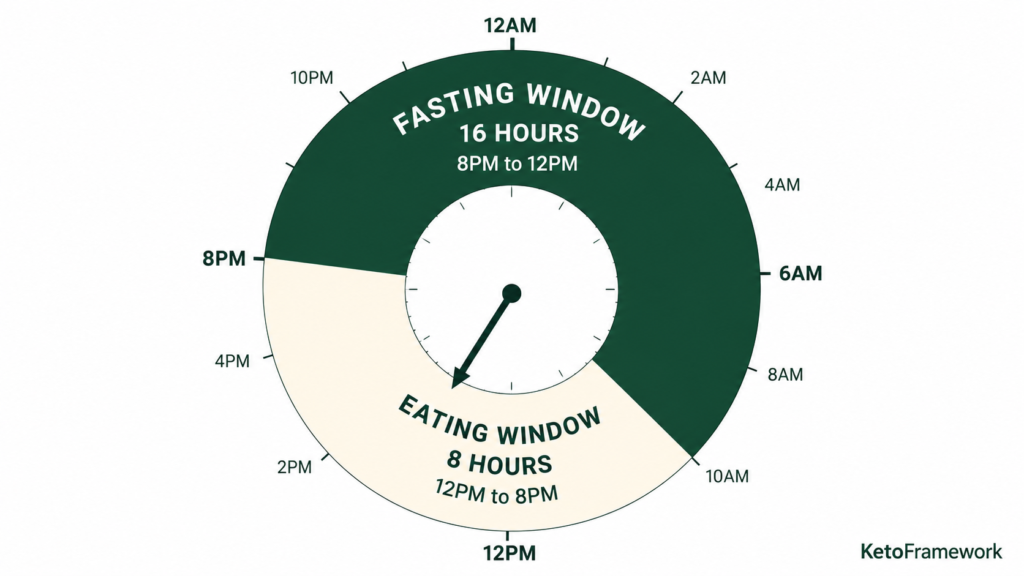
Intermittent fasting is an eating pattern that alternates between periods of eating and periods of not eating. That is the intermittent fasting definition in its simplest form. You eat during a specific window of time each day and you fast for the hours outside that window.
The eating window and the fasting window together make up 24 hours. Common examples of what is intermittent fasting in practice:
| IF method | Fasting window | Eating window | Example schedule |
| 14:10 | 14 hours | 10 hours | Last meal at 8pm, first meal at 10am |
| 16:8 | 16 hours | 8 hours | Last meal at 8pm, first meal at 12pm |
| 18:6 | 18 hours | 6 hours | Last meal at 6pm, first meal at 12pm |
| 5:2 | Two low-calorie days per week | Five normal eating days | Monday and Thursday restricted, rest normal |
| OMAD | 23 hours | 1 hour | One meal per day at a consistent time |
The fasting period is not starvation. It is simply the time between your last meal of one day and your first meal of the next. Most people already fast for eight to ten hours overnight while sleeping. Intermittent fasting extends that window intentionally.
What makes intermittent fasting different from a calorie-restriction diet is the biological mechanism. It is not primarily about eating less food overall, though that often happens naturally. It is about creating a window of time long enough for insulin to fall, which triggers a set of metabolic changes that calorie restriction alone does not reliably produce.
Intermittent Fasting Explained: What Is Actually Happening in Your Body
To understand intermittent fasting explained properly, you need to understand one hormone: insulin. Everything else follows from there.
The insulin connection: why timing matters
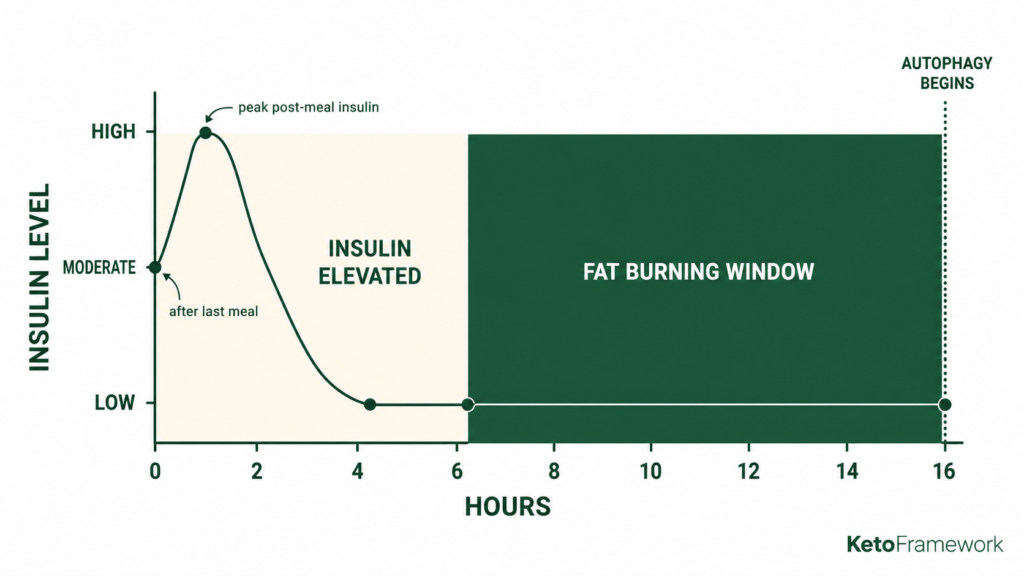
Every time you eat, your blood glucose rises and your pancreas releases insulin to manage it. Insulin’s job is to move glucose into cells for energy and to store the excess as glycogen or fat. While insulin is elevated, your body cannot access stored fat for energy. Fat burning is suppressed for as long as insulin remains high.
After a meal, insulin typically takes two to three hours to return to baseline levels. If you eat again before that happens, insulin rises again and the fat-burning window never fully opens. On a typical eating pattern of three meals and snacks spread throughout the day, insulin is elevated for most of the waking hours and the body rarely gets a sustained opportunity to burn stored fat.
Intermittent fasting changes this by creating a long enough gap between the last meal and the first meal that insulin has time to fall fully and stay low for several hours. A study published in PMC (Longo and Panda, Cell Metabolism, 2016) confirmed that time-restricted feeding produces significant metabolic improvements including reduced insulin levels, improved fat oxidation, and better metabolic flexibility, even without deliberate calorie restriction. [1]
What happens hour by hour during the fasting window
| Hours fasted | What is happening in the body | What you typically feel |
| 0 to 4 hours | Digesting the last meal. Insulin elevated. Glucose being used for energy. | Normal. Satisfied after eating. |
| 4 to 8 hours | Insulin returning to baseline. Blood glucose stabilising. Glycogen beginning to be used. | Possible mild hunger if not yet adapted to fasting. |
| 8 to 12 hours | Insulin at baseline or below. Body beginning to draw on liver glycogen. Early fat oxidation increasing. | Hunger may peak around hour 10 to 12 for new fasters. This fades with adaptation. |
| 12 to 16 hours | Liver glycogen substantially depleted. Fat oxidation significantly increased. Ketone production beginning in some people. | For adapted fasters: stable energy, reduced hunger, mental clarity often improving. |
| 16 to 18 hours | Full fat-burning mode. Ketone levels measurable. Autophagy (cellular repair) beginning to activate. | Experienced fasters often report their clearest energy and focus in this window. |
| 18 hours plus | Deep fasting state. Ketone production elevated. Autophagy active. Growth hormone increasing. | Advanced fasters. Not recommended for beginners without guidance. |
How Does Intermittent Fasting Work: The Biology Without the Jargon
How does intermittent fasting work in plain terms? Here is the version I wish I had found before I started.
Your body has two fuel modes. Mode one uses glucose from food you have recently eaten. Mode two uses stored fat. Mode one is always preferred when glucose is available because insulin keeps the door to mode two firmly closed.
Intermittent fasting works by keeping you in a state where insulin is low for long enough that the door to mode two opens and stays open for several hours. In that window your body is actively drawing on stored fat for fuel. It is burning what you have already put away rather than what you just ate.
When my wife and I both started tracking our eating windows consistently, the change in appetite was the first thing we both noticed. Not weight loss. Appetite. The constant low-level hunger that had been background noise in daily life went quiet. That is the insulin mechanism working. You are no longer eating to feed a blood sugar cycle. You are eating because you are genuinely hungry.
The research on how does intermittent fasting work confirms this mechanism clearly. A review published in PubMed (Patterson and Sears, Annual Review of Nutrition, 2017) found that intermittent fasting produces measurable improvements in insulin sensitivity, fat oxidation rates, and metabolic flexibility, with the primary mechanism being the sustained low-insulin environment created by the fasting window. [2]
What intermittent fasting is not
Intermittent fasting is not starvation. Starvation is involuntary and chronic. Intermittent fasting is structured and temporary, with regular eating windows every day.
Intermittent fasting is not the same as skipping meals randomly. The timing and consistency of the eating and fasting windows are what produce the metabolic benefits. An irregular eating pattern with no structure does not produce the same results.
Intermittent fasting is not a licence to eat anything during the eating window. Food quality still matters. A 16-hour fast followed by a six-hour window of processed food and refined sugar will not produce the results that the same fasting window combined with whole food eating produces.
What Is the IF Diet: The Different Methods and Which One Fits Your Life
What is the IF diet in practice? The term covers several different approaches. The right one depends on your lifestyle, your experience with fasting, and what you are trying to achieve.
14:10 — the gentlest starting point
A 14-hour fasting window with a 10-hour eating window. If you stop eating at 8pm and have your first meal at 10am, you are doing 14:10. Most people who sleep eight hours are already doing 10 to 12 hours of overnight fasting without thinking about it. Extending to 14 hours requires finishing dinner slightly earlier or pushing breakfast slightly later. This is where my wife and I both started. It is what I recommend to everyone.
16:8 — the most widely researched IF protocol
A 16-hour fasting window with an 8-hour eating window. Most people structure this as finishing dinner by 8pm and not eating until 12pm the next day. The 16:8 protocol is the most studied of all intermittent fasting methods and the one with the strongest research evidence for weight loss, insulin improvement, and metabolic benefits.
18:6 — the protocol we both settled into
An 18-hour fasting window with a 6-hour eating window. After about six weeks of 16:8, both my wife and I moved naturally to 18:6. The eating window typically runs from 12pm to 6pm. It feels more natural than it sounds once you are adapted because the hunger that comes in the morning largely disappears after the first two weeks of consistent fasting.
5:2 — fasting by the day rather than the hour
Five normal eating days and two very low calorie days (typically 500 to 600 calories) per week. The two restricted days do not need to be consecutive. This approach suits people whose daily schedules make a consistent eating window difficult but who can commit to two structured days per week.
Combining intermittent fasting with keto
Intermittent fasting and keto work exceptionally well together because they address the same underlying mechanism from two directions. Keto lowers insulin by removing carbohydrates. Intermittent fasting lowers insulin by extending the gap between meals. Combined, they produce a faster entry into ketosis, better fat oxidation rates, and stronger appetite suppression than either approach alone. The full guide on intermittent fasting and keto combined covers how to structure both together. For the complete keto framework that pairs with IF, the complete keto diet plan covers everything.
Intermittent Fasting for Beginners: Where to Start and What to Expect
Intermittent fasting for beginners is simpler than it looks from the outside. Here is what worked for us and what I recommend to everyone who asks where to start.
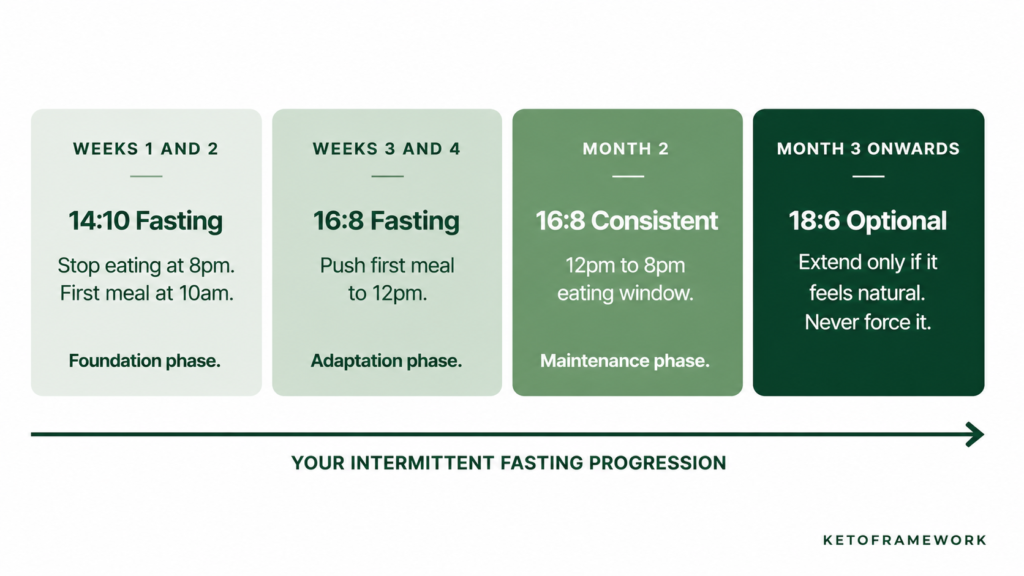
Start with 14:10 for the first two weeks
Do not begin with 16:8 or 18:6. Begin with 14:10. Stop eating two hours earlier than you normally would in the evening and have your first meal two hours later than you normally would in the morning. That is it. Two changes. No complicated planning.
The first three to four days of intermittent fasting for beginners will involve some hunger in the morning during the extended fasting window. This is normal. It is your body expecting food at the time it is used to receiving it. It passes within a week for most people as your hunger hormones adapt to the new pattern. My wife noticed the morning hunger dropped significantly by day five. Mine took until day seven. Both timelines are normal.
Manage electrolytes from day one
The most common mistake in intermittent fasting for beginners is not managing electrolytes during the fasting window. During a fast your kidneys excrete more sodium, which pulls magnesium and potassium with it. The headaches and fatigue that beginners often experience in the first week of IF are usually electrolyte depletion, not starvation. A glass of water with a pinch of sea salt in the morning solves most of it. The full electrolyte protocol is in the electrolytes on keto guide, which applies equally to IF whether you are doing keto or not.
What you can consume during the fasting window
During the fasting window, anything that does not raise insulin keeps the fast metabolically intact. The practical list:
| Allowed during the fasting windowWater — still or sparkling, as much as you wantBlack coffee — no milk, no sugar, no sweeteners. Plain black coffee does not raise insulin and does not break a fast.Plain herbal tea — no milk, no sweetenerPlain green tea or black tea — no milk, no sweetenerWater with lemon — a squeeze of lemon in water is negligible in insulin impactElectrolytes — plain electrolyte powder with no sugar or sweetenerNOT allowed: milk, cream, any food, fruit juice, sweetened drinks, protein shakes, gum with sugar |
Move to 16:8 after two to three weeks
Once the hunger in the morning has largely disappeared and 14:10 feels natural, extend the fasting window to 16 hours. This usually means pushing the first meal from 10am to 12pm. The jump from 14 to 16 hours feels significant before you do it and entirely manageable within a few days of doing it.
For the complete beginner framework including what to eat during the eating window, the complete intermittent fasting diet plan covers every step. And if you are new to low-carb eating alongside IF, the keto diet for beginners 30-day guide is the natural companion.
What Is Intermittent Fasting Good For: The Documented Benefits
What is intermittent fasting good for beyond weight loss? The research covers several areas. Here are the ones confirmed in peer-reviewed studies rather than the ones that are often repeated without evidence.
| Benefit | What the research shows | How long it takes to appear |
| Weight and fat loss | Intermittent fasting produces significant fat loss, particularly visceral fat, through the combined effect of insulin reduction and natural calorie reduction from a shorter eating window | 4 to 12 weeks of consistent IF |
| Improved insulin sensitivity | Fasting periods lower baseline insulin levels and improve how efficiently cells respond to insulin, directly addressing insulin resistance | 2 to 4 weeks of consistent IF |
| Reduced inflammation | Extended fasting periods reduce inflammatory markers including CRP and IL-6, which are linked to chronic disease risk | 8 to 12 weeks of consistent IF |
| Autophagy activation | After approximately 16 to 18 hours of fasting, the body activates autophagy: a cellular repair process that clears damaged cell components | Each fasting cycle if the window is long enough |
| Improved metabolic flexibility | The body becomes better at switching between glucose and fat as fuel sources, improving energy stability and reducing dependence on frequent eating | 4 to 8 weeks of consistent IF |
| Appetite regulation | Consistent IF improves the regulation of ghrelin (the hunger hormone) reducing the intensity and frequency of hunger signals over time | 2 to 4 weeks of consistent IF |
A systematic review published in PMC (Stockman et al., Current Obesity Reports, 2018) reviewed multiple intermittent fasting protocols and found consistent evidence of weight loss, improved metabolic markers, and reduced cardiovascular risk factors across the major IF methods, with the strongest evidence for 16:8 and alternate day fasting protocols. [3]
Frequently Asked Questions About What Intermittent Fasting Is
What is intermittent fasting in simple terms?
Intermittent fasting is an eating pattern where you eat during a specific window of time each day and fast for the remaining hours. The most common version is 16:8, which means fasting for 16 hours and eating during an 8-hour window. What is intermittent fasting at its core is simply a structured approach to when you eat, designed to lower insulin for long enough that your body burns stored fat for fuel. It is not a specific diet. It is a timing framework that you can apply to any way of eating.
How does intermittent fasting work for weight loss?
How does intermittent fasting work for weight loss comes down to two mechanisms working together. First, extending the fasting window lowers insulin for several hours, opening the door to fat burning that is suppressed while insulin is elevated. Second, eating within a shorter window naturally reduces total calorie intake for most people without deliberate calorie counting, because there is simply less time to eat. The combination of lower insulin and moderate natural calorie reduction produces consistent fat loss that most people find easier to sustain than traditional calorie restriction.
What is the IF diet and how do I choose a method?
What is the IF diet is a question best answered by your lifestyle rather than by the research. 14:10 is the right starting point for beginners because it is the most manageable change from a typical eating pattern. 16:8 is the most researched and most widely used method and suits most people once they have adapted to fasting. 18:6 is what my wife and I both use now and works well for people who have been doing IF for several weeks and want to extend the fat-burning window. 5:2 suits people whose daily schedule makes a consistent eating window difficult. The best IF method is the one you can do consistently.
Is intermittent fasting for beginners safe?
Intermittent fasting for beginners is safe for most healthy adults. The most common issues in the first week are hunger, mild headaches, and fatigue, all of which are primarily electrolyte-related and resolve with proper hydration and a pinch of sea salt in water. Intermittent fasting is not recommended for pregnant or breastfeeding women, people with a history of eating disorders, or people on certain medications that require food intake. If you have any existing health condition, consult your doctor before starting.
What is the intermittent fasting definition compared to calorie restriction?
The intermittent fasting definition focuses on timing: when you eat. Calorie restriction focuses on quantity: how much you eat. The practical difference is that intermittent fasting produces metabolic benefits through the low-insulin fasting period that calorie restriction does not necessarily produce. You can eat 1,500 calories spread across 16 hours of a day and never give your insulin enough time to fall fully. Eating 1,500 calories within a 6-hour window produces the same calorie intake but with a sustained 18-hour low-insulin period that actively promotes fat burning and metabolic repair.
How long before intermittent fasting starts working?
Most people notice reduced hunger and more stable energy within the first week to two weeks of consistent intermittent fasting as hunger hormones adapt to the new eating pattern. Measurable changes in weight typically appear within two to four weeks. Improvements in insulin sensitivity and metabolic markers are measurable at four to eight weeks of consistent IF. The full benefits of intermittent fasting, including improved metabolic flexibility, reduced inflammation, and reliable autophagy activation, develop over eight to twelve weeks of consistent practice. Consistency matters more than which specific IF method you choose.
What Is Intermittent Fasting: The One Thing Worth Remembering
What is intermittent fasting at its simplest: a window of not eating long enough for insulin to fall and fat burning to activate. That is the whole mechanism. Everything else, the specific methods, the eating windows, the food choices during the eating period, is built on top of that one idea.
The reason intermittent fasting worked for my wife and for me when other approaches had not is that it changes the hormonal environment rather than just the calorie count. You are not fighting hunger with willpower. You are giving your body long enough without food that it stops looking for food and starts using what it has stored. Once you have experienced that shift the approach becomes intuitive rather than effortful.
Start with 14:10. Give it two weeks. Pay attention to your energy and your hunger. Then decide whether to stay there or extend to 16:8.
The complete framework for every IF method, meal timing, and what to eat during the eating window is in the complete intermittent fasting diet plan. And for testing whether your fasting has pushed you into ketosis, the guide on how to test for ketosis covers every method.
References
All sources cited in this article are peer-reviewed studies sourced from PubMed or PMC. This article is for informational purposes and does not constitute medical advice.
1. Longo VD, Panda S. Fasting, circadian rhythms, and time-restricted feeding in healthy lifespan. PMC, Cell Metabolism, 2016
2. Patterson RE, Sears DD. Metabolic effects of intermittent fasting. PubMed, Annual Review of Nutrition, 20173. Stockman MC, Thomas D, Burke J, Apovian CM. Intermittent fasting: is the wait worth the weight?. PMC, Current Obesity Reports, 2018