
The first time I flew on keto I spent a week panicking about what I would eat at the airport, and then got there and found eggs, cheese, nuts, a black coffee, and a grilled chicken salad within five minutes of arriving at my gate.
Keto diet while traveling is one of the situations people worry about most before they have done it, and one of the things that turns out to be most manageable once they try it. The worry usually comes from the assumption that staying keto requires a controlled kitchen and a specific shopping list. The reality is that keto is built around foods, protein, fat, and vegetables, that exist in recognisable form at almost every airport, service station, supermarket, restaurant, and hotel in the world.This guide covers everything practical: what to pack as keto travel snacks, how to navigate airports on keto, how to manage road trips, how to eat keto in a hotel without a kitchen, how to approach keto abroad in different countries, and the simple mindset adjustment that makes the whole thing less stressful than most beginners expect. For the ordering rules that apply at restaurants anywhere in the world, the keto fast food guide is the right companion article to bookmark before you travel.
Before You Leave: The Travel Keto Mindset

The most useful reframe for keto travel is this: you are not looking for keto meals. You are looking for protein and fat with minimal carbohydrate, which is available in recognisable form almost everywhere in the world. Eggs exist globally. Grilled meat exists globally. Cheese exists globally. Hard-boiled eggs, cheese, a handful of nuts, some olives, a black coffee, and a piece of grilled chicken are not exotic requests at any food outlet. They are basic foods available in every country.
The second useful adjustment is calibrating expectations for the quality and variety of keto eating while traveling. At home you can cook exactly what you want. Traveling, you are adapting to what is available. This is fine. One week or two weeks of simplified, less varied keto meals does not undo months of progress. The goal while traveling is to stay low enough in carbohydrates to maintain ketosis or at least to return to it quickly, not to eat the most optimised possible keto diet every day.
The third adjustment is deciding your travel approach before you leave rather than improvising. There are three viable strategies: strict keto throughout (most effective, requires the most planning), low-carb maintenance without strict tracking (easiest, involves higher carb tolerance on some days), or scheduled breaks and return to keto on return. All three are legitimate choices. The strategy you choose determines how much preparation you need.
Keto Travel Snacks: What to Pack for Any Journey
Packing your own snacks is the most reliable keto travel strategy. It removes the reliance on finding appropriate food at airports, service stations, or on aeroplanes, and it keeps you within ketosis during the windows between meals when hunger is most likely to push you toward a high-carb convenience option.
| Snack | Net carbs | Why it travels well |
| Mixed nuts (almonds, walnuts, macadamia) | 2 to 4g per 30g | Shelf-stable, dense in fat, satisfying. Pre-portion into 30g bags to prevent overeating |
| Hard cheese portions | 0 to 1g per 30g | Mature cheddar, gouda, or parmesan travel well for 6 to 8 hours without refrigeration |
| Pork scratching or pork rinds | 0g | Zero carbs, high fat, extremely portable. UK brands include Awfully Posh and Serious Pig |
| Tinned salmon or sardines (ring-pull) | 0g | Protein and omega-3 rich. Ring-pull tins need no utensils. Pair with cucumber slices |
| Beef jerky or biltong | 2 to 3g per 30g | Check labels for added sugar. Low-sugar versions available from Tesco, Waitrose, and Amazon |
| Almond or peanut butter sachets | 3 to 4g per sachet | Single-portion sachets from various brands. Pair with celery sticks or eat straight |
| Hard-boiled eggs (pre-cooked) | 0g | Boil and cool the night before. Last 8 to 12 hours without refrigeration in a cooler |
| Olives (vacuum-sealed pouches) | 1g per portion | Travel-stable olives available in single-portion sealed pouches. High in fat |
| Dark chocolate (85 percent or above) | 4 to 6g per 30g | One to two squares for hunger management. Avoid anything below 85 percent |
| Protein bars (verified low-carb) | 4 to 8g | Check carefully: Bulk Macro Munch, Grenade, and Quest bars are among the lower carb options |
| The travel snack pack systemThe night before any trip, assemble a small bag containing: two 30g portions of mixed nuts in separate zip-lock bags, two hard cheese portions, one packet of pork scratching, one almond butter sachet, and two hard-boiled eggs. This pack contains approximately 1,000 calories of keto-compatible food with under 15 grams of total net carbs, which covers a full day of travel snacking without needing to find a single specific food outlet. |
Keto at Airports: How to Eat Keto in Any Terminal
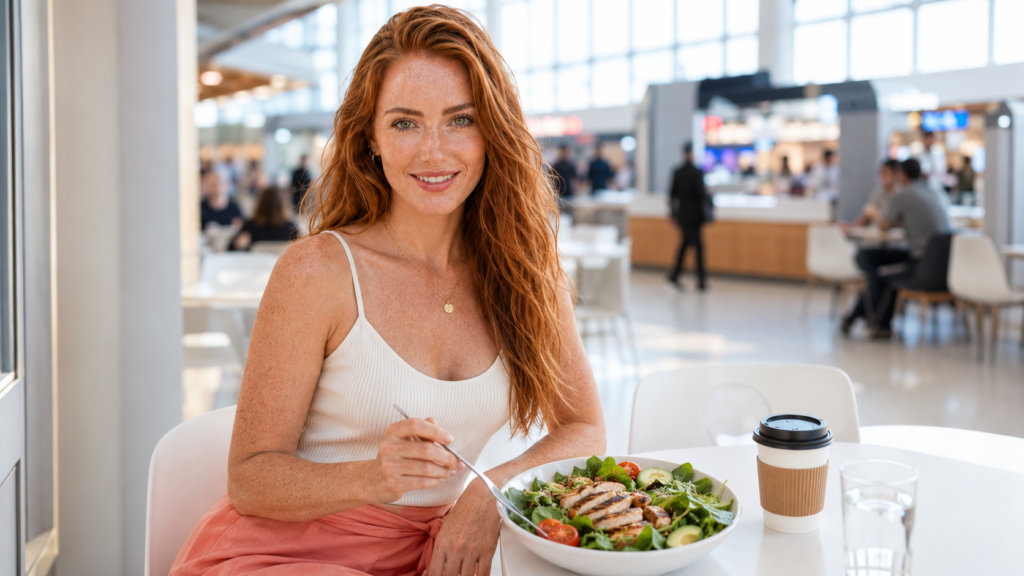
Most major airports in the UK and Europe contain multiple food options that are keto-compatible with minor modifications. The trick is knowing where to look and what to ask for, rather than searching for a specifically labelled keto option.
Before security
Before security is the best time to pack additional fresh food that would otherwise be confiscated. Add hard-boiled eggs, fresh cheese portions, and avocado halves to your carry-on bag before the security checkpoint. Whole pieces of fruit, cured meats, and cheese are all permitted in hand luggage. Liquids above 100ml are not, which rules out nut butter jars but allows single-portion sachets.
After security: where to find keto food at UK airports
| Outlet type | Best keto options | What to avoid |
| Pret a Manger | Egg salad pot, crayfish and avocado salad pot, chicken and avocado salad, black coffee, sparkling water | All sandwiches, wraps, croissants, porridge, crisps |
| Itsu | Edamame, tuna sashimi, salmon sashimi plates, miso soup (low carb), seaweed salad | All sushi rice, noodles, dumplings, teriyaki |
| Greggs (limited options) | Sausage roll without the pastry (remove it), bacon roll without the roll. Not ideal | Everything bread-based; very limited for strict keto |
| WHSmith or airport shop | Nuts (unsalted), pork scratching packs, beef jerky, hard cheese portions, water | Sandwiches, crisps, chocolate, fruit juice, energy drinks |
| Sit-down restaurant | Grilled protein with salad or green vegetables. Apply the keto restaurant ordering rules | All pasta, pizza, and risotto. Check sauces for hidden sugar |
| Coffee shop (Starbucks, Costa) | Black Americano, black filter coffee, sparkling water, still water | All frappuccinos, flavoured lattes, hot chocolates. Check milk additions |
At airports outside the UK, the same principle applies: look for protein-based food, modify away from bread and sauces, and drink water or black coffee. Most international airports have at least one sit-down restaurant where a grilled protein with salad or vegetables can be ordered with minor modifications.
Keto on a Road Trip: Service Stations and Long Drives

Road trips present specific keto challenges: motorway service stations in the UK are dominated by carbohydrate-heavy food, petrol station shops are built around snacks that are almost entirely carbohydrate, and the temptation of convenience food is highest when you are hungry after two hours of driving. The solution is preparation rather than willpower.
Prepare a road trip cooler
If driving, a small cooler bag in the back seat transforms the keto road trip experience. Pack it the night before with: hard-boiled eggs, sliced cheese, cherry tomatoes (low carb in small amounts), small portions of cooked chicken, almond butter sachets, a portion of mixed nuts, sparkling water, and a large bottle of still water. A full day of travel with a prepared cooler requires zero keto-specific food stops. You eat from the cooler at service stations rather than entering the food outlets, which removes the temptation entirely.
At UK motorway service stations
| What you will find | Keto-compatible option | Net carbs approx. |
| M&S Simply Food | Egg and cress salad pot, smoked salmon and cream cheese, mixed nuts, cheese board portion | 3 to 8g depending on choice |
| Burger King or McDonald’s | Bunless burger with no ketchup. Apply fast food keto ordering rules | 3 to 5g with correct modifications |
| Costa or Starbucks | Black Americano, sparkling water, unsweetened cold brew | 0g |
| WH Smith | Pork scratching packs, nuts, beef jerky, dark chocolate (85 percent) | 2 to 5g per serving |
| Greggs | Sausage without the roll (or eat the filling only), plain bacon if available | 1 to 2g for meat only |
| Subway | Protein salad bowl (any filling, no bread, no croutons) | 5 to 8g |
The safest road trip keto strategy is to treat service station stops as coffee and bathroom breaks only, eating exclusively from your prepared cooler. If you need to buy something, WH Smith nuts and pork scratching packs and a black coffee from Costa are available at virtually every UK motorway service station and cover hunger effectively with under 5 grams of net carbs.
Keto in a Hotel Room: No Kitchen Required
Book a hotel with a minibar or mini fridge
Many hotels provide a mini fridge in the room even when not listed. Call ahead and ask whether a fridge is available or can be provided. A fridge allows you to store bought food from a local supermarket: hard cheese, cooked chicken from a deli counter, smoked salmon, cream cheese, butter portions, and hard-boiled eggs. This single addition transforms a hotel stay from reliant-on-restaurants to mostly self-sufficient.
Use the hotel breakfast strategically
Hotel breakfasts are one of the best keto travel opportunities, not a challenge. A standard hotel breakfast buffet contains eggs (scrambled or fried), bacon or sausages, smoked salmon, hard cheese, butter, full-fat cream or milk for coffee, and often sliced meats. Skip the toast, cereals, pastries, fruit juices, and hash browns and load up on the protein and fat options. A hotel breakfast of eggs, bacon, cheese, and black coffee costs approximately 2 to 4 grams of net carbs and will keep you full until mid-afternoon, simplifying the whole day’s food planning.
Supermarket strategy in any city
In any city in the world, a local supermarket or grocery store is the fastest and cheapest keto food source. The keto supermarket shopping list works almost universally: look for the protein section (pre-cooked chicken, tinned fish, hard-boiled eggs, cold cuts), the cheese section, the nut section, and the olive oil and avocado section. These foods exist in most supermarkets worldwide and require no cooking, no fridge beyond the hotel mini fridge, and no utensils beyond a knife.
Keto Diet Abroad: Country-by-Country Tips
Different cuisines and food cultures present different keto challenges and opportunities when traveling abroad:
| Country or region | Keto-friendly foods to look for | Main challenges | Key phrase to know |
| France | Grilled meat and fish, cheese and charcuterie boards, omelettes, salads with vinaigrette | Bread served automatically at every meal. Sauces often contain flour | Sans pain (without bread); sans sauce (without sauce) |
| Spain / Mediterranean | Grilled fish and seafood, jambon serrano, manchego cheese, tortilla espanola (egg only) | Bread with every course, tapas often include bread bases | Sin pan (without bread) |
| Italy | Grilled meat or fish, antipasto plate, caprese salad, prosciutto and mozzarella | Pasta and pizza everywhere. Very limited non-pasta mains at casual restaurants | Senza pane (without bread); senza pasta (without pasta) |
| Germany and Austria | Grilled sausages, pork knuckle, sauerkraut, hard cheese, eggs at breakfast | Pretzels, bread with every meal, potato sides common | Ohne Brot (without bread) |
| Greece | Grilled lamb, chicken souvlaki without pitta, Greek salad, feta cheese, tzatziki | Pitta served with everything. Watch for honey in dressings | Choris pitta (without pitta) |
| Japan | Sashimi, miso soup, yakitori (grilled chicken), edamame, gyoza filling without dumpling skin | Rice with everything, noodle-heavy cuisine, soy sauces may contain sugar | Gohan nashi de (without rice) |
| USA and Canada | Bunless burgers at all chains, grilled chicken salads, steak with green vegetables, eggs at breakfast | Portion sizes very large; sweet sauces applied automatically | No bun, no ketchup |
The single most useful keto travel phrase in any country is the equivalent of: ‘Can I have this without the bread, rice, or pasta, with extra salad or vegetables instead?’ Most waitstaff across Europe and beyond will understand this request even with imperfect language, and most kitchens will accommodate it without significant difficulty.
Frequently Asked Questions
How do you stay keto on vacation?
The most effective approach is to pack keto travel snacks for the journey, identify local supermarket and restaurant options at your destination before you arrive, and apply the universal restaurant ordering rules consistently: remove bread, rice, and pasta; avoid sweet sauces; choose grilled protein with salad or vegetables. You do not need to find specifically labelled keto food. You need protein and fat with minimal carbohydrate, which is available in recognisable form at virtually every food outlet worldwide. Accepting that variety will be lower than at home and that occasional imperfect meals are not a problem is the mental adjustment that makes keto travel genuinely relaxed rather than stressful.
What are the best keto travel snacks?
Mixed nuts portioned into 30-gram bags, hard cheese portions, pork scratching packs, beef jerky or biltong (check for added sugar), hard-boiled eggs pre-cooked the night before travel, single-portion almond butter sachets, olive pouches, and dark chocolate at 85 percent or above are the most practical keto travel snacks for any journey. All of these are shelf-stable for at least several hours, available from UK supermarkets before departure, require no preparation at the point of eating, and together cover a full day of travel without requiring a single specifically keto food outlet.
What can I eat at airports on keto?
Pret a Manger egg salad pots and chicken salads, Itsu sashimi and edamame, nuts and pork scratching packs from WHSmith, a bunless burger at a fast food outlet, or a grilled protein with salad at any sit-down airport restaurant are all viable keto airport options in UK and most European airports. The single most consistently available keto airport option is a black Americano from any coffee shop and a bag of nuts or a pork scratching pack from WHSmith. This combination costs under six pounds, contains under 5 grams of net carbs, and is available at virtually every UK airport terminal.
Does keto get harder to maintain when traveling internationally?
Keto gets slightly more complex internationally because the food labelling, the default dishes, and the language barrier make modifications harder to communicate. Mediterranean countries, including France, Spain, Italy, and Greece, are actually among the easiest international destinations for keto because their cuisines are built around olive oil, grilled protein, vegetables, and cheese, all of which are naturally keto-compatible. Asian cuisines are more challenging because rice is the default carbohydrate at almost every meal, but sashimi, grilled meat, and steamed fish are available at most Japanese, Chinese, and Southeast Asian restaurants. The country-by-country table above covers the specific ordering approach for the most common international destinations.
What if I accidentally eat too many carbs while traveling?A single meal or single day of higher carbohydrate intake while traveling does not permanently disrupt your ketogenic progress. Glycogen stores will refill, water weight will temporarily increase by two to three kilograms, and you will exit ketosis. Returning to strict keto eating when you return home will restore ketosis within two to four days for most fat-adapted people. The practical response to an accidentally high-carb meal while traveling is to return to keto eating at the next meal rather than treating the day as a written-off occasion. The sooner you return to low-carb eating, the faster ketosis is restored. Pairing the return to keto with a fasting window the following morning will accelerate re-entry into ketosis, as covered in the intermittent fasting and keto guide.

Pack the Snacks, Know the Rules, and Keto Travel Is Easy
Keto diet while traveling is manageable for one practical reason: the foundational foods of a ketogenic diet, protein, fat, and low-carb vegetables, are universal. They exist in airports, service stations, supermarkets, and restaurants in every country you are likely to visit. The skill is not finding specifically keto food. It is recognising which food is already compatible and applying simple modifications when eating out.
Prepare a snack pack before every journey. Learn the hotel breakfast strategy. Identify the nearest supermarket at your destination. Apply the five universal restaurant ordering rules at every meal. These four habits cover the vast majority of keto travel scenarios without requiring any specialist food, any complicated planning, or any feeling of deprivation on a trip.
For the complete ordering guide to use at restaurants and fast food chains worldwide, theketo fast food guide is the reference to keep on your phone while traveling. And for what to eat when you get home and want to reestablish your full keto routine after the trip, the lazy keto meal plan for beginners provides a ready-made week of meals from day one.